
Strategy rarely fails at the boardroom table. It stalls in the space between high-level governance and operational reality. As organisations grow, internal reporting and compliance frameworks often slow commercial velocity instead of driving execution. Management teams become consumed by operational detail, while boards lose clear visibility of strategic progress. Engaging independent board advisory services introduces the practical, commercially grounded challenge required to break this inertia and restore operational traction.
You already know the frustration of watching well-formulated strategies unravel during daily delivery. After all, business alignment isn’t about forcing consensus; it’s about getting leadership and operational teams working toward the exact same outcome. In this article, you will discover how modern board advisory bridges the divide between boardroom oversight and disciplined execution. We break down the differences between statutory and advisory governance, share a practical framework for embedding advisors, and outline how to unite your executive team around an execution model that delivers sustained enterprise value.
Key Takeaways
- Learn why growing organisations rely on independent executive perspectives to steer complex transitions without adding bureaucratic drag.
- Understand the distinct boundary between statutory fiduciary oversight and board advisory services to preserve commercial velocity.
- Discover how operational alignment connects boardroom strategy to daily execution, focusing leadership on shared commercial outcomes rather than consensus.
- Gain a practical framework to select and embed advisory partners with proven executive experience into your existing governance rhythm.
What Are Board Advisory Services and Why Do Modern Organisations Need Them?
Board advisory services deliver independent strategic counsel directly to directors, business owners, and executive leaders. They provide structured, external guidance without the statutory encumbrance of a fiduciary directorship. Operating environments shift rapidly. Navigating digital disruption, supply chain pressures, and margin compression demands seasoned perspectives. Advisory boards act as agile sounding boards, evaluating critical risks, capital allocation, and performance friction before decisions commit enterprise resources. External advisors protect commercial value by establishing dispassionate accountability and independent challenge.
The Evolving Mandate of the Modern Corporate Board
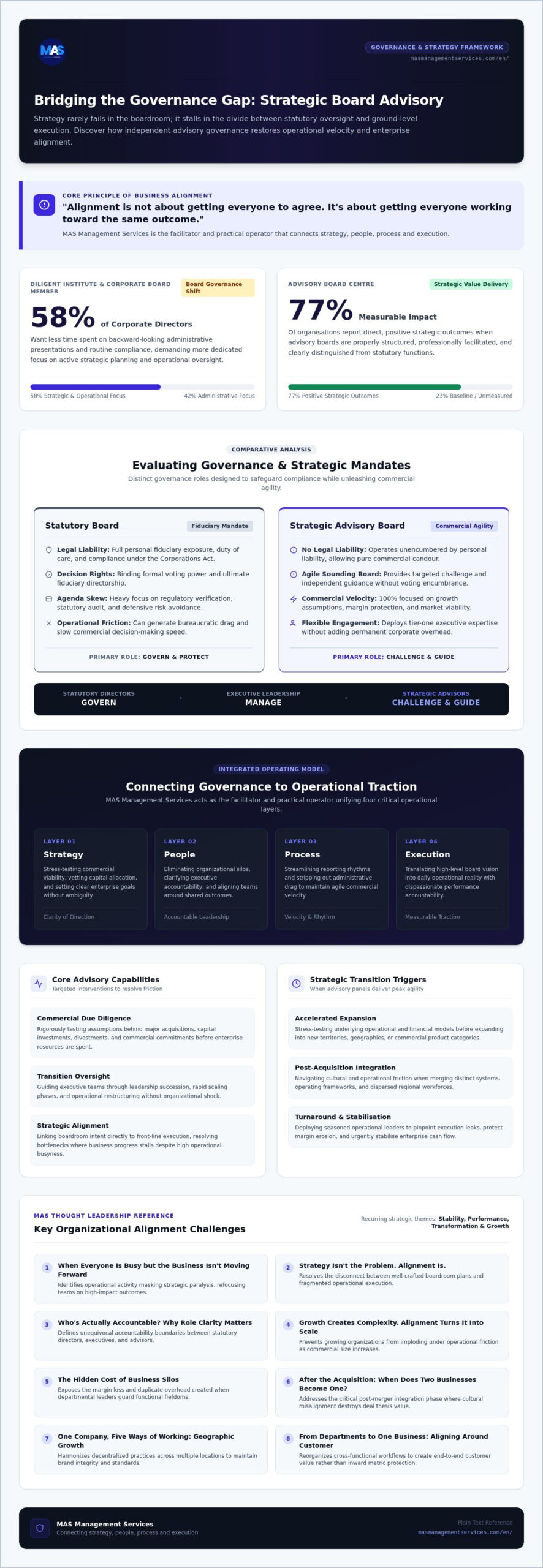
Governance expectations have shifted decisively from backward-looking oversight to active strategic stewardship. Boards can no longer function purely as quarterly compliance monitors. Research by Diligent Institute and Corporate Board Member shows that 58% of corporate directors want less time spent on administrative presentations and more focus on strategic planning and operational oversight. Macroeconomic volatility and capital constraints demand constant stress-testing of commercial models. Independent advisors help boards bridge long-term vision with immediate delivery realities, ensuring ambitions match ground-level capabilities.
Core Capabilities Provided by Strategic Board Advisors
Experienced advisors step in to resolve internal friction and bring discipline to high-stakes decisions. They evaluate capital investments, challenge growth assumptions, and sharpen leadership accountability. Their involvement typically centres on several key areas:
- Commercial Due Diligence: Rigorously testing assumptions behind major acquisitions, capital expenditure, and divestments.
- Transition Oversight: Supporting leadership during succession, rapid scale, or structural turnaround.
- Strategic Alignment: Linking boardroom intent directly to operational execution.
When businesses experience drag, leaders often find themselves asking why everyone is busy but the business isn’t moving forward. Strategic advisors pinpoint these execution bottlenecks, cutting through operational noise to restore commercial velocity.
Statutory Board vs Advisory Board: Evaluating Governance and Strategic Value
A common governance mistake is treating advisory boards as lesser versions of statutory boards. They serve entirely distinct commercial purposes. Statutory boards bear formal fiduciary duties, voting power, and legal accountability for corporate governance under the Corporations Act. In contrast, board advisory services provide targeted, strategic counsel without legal liability or voting rights. This distinction liberates advisors to focus solely on commercial viability, unburdened by administrative compliance.
Legal Liability and Fiduciary Duties Compared
Statutory directorship carries heavy legal exposure, including duties of care, diligence, and good faith. Because of this personal risk, formal board meetings naturally skew toward regulatory compliance, audit sign-offs, and risk mitigation. Advisors operate outside this statutory liability. Their mandate is not compliance verification; it is commercial performance. An advisory board provides objective, unvarnished insight precisely because its members are not managing personal legal risk.
When an Advisory Board Delivers Superior Strategic Agility
Mid-market and private organisations frequently use advisory panels to access tier-one executive talent on flexible terms. Rather than adding permanent corporate overhead, businesses deploy advisors to navigate specific transition windows:
- Accelerated Expansion: Stress-testing operational models before entering new territories or product categories.
- Post-Acquisition Integration: Managing operational friction when merging cultures and systems.
- Turnaround and Stabilisation: Bringing in seasoned operational leaders to stabilise cash flow and improve margins.
According to the Advisory Board Centre, 77% of organisations report positive strategic outcomes when advisory boards are properly structured and facilitated. The key lies in role distinction. When business leaders ask who’s actually accountable and why role clarity matters, the governance answer is simple: statutory directors govern, executives manage, and strategic advisors challenge and guide. For organisations seeking this balance, engaging specialist Board & Strategic Advisory delivers elite executive insight with immediate commercial agility. Smaller enterprises often underestimate the value of this discipline, yet strategic oversight for SMEs is equally critical to protecting commercial momentum and building resilient scale.
Driving Strategic and Operational Alignment: Moving from Governance to Execution
Strategy isn’t the problem. Alignment is. Well-crafted strategies frequently falter because boardroom intent never reaches operational workflows. Alignment is not about getting everyone to agree; it’s about getting everyone working toward the same outcome. Practical board advisory services bridge this divide using a structured four-stage execution framework:
- Strategic Clarity: Define specific commercial outcomes, not vague aspirational goals.
- Operational Structure: Remove business silos that isolate functional teams.
- Performance Accountability: Establish unequivocal individual ownership over key milestones.
- Disciplined Cadence: Maintain regular operational reviews to monitor progress.
Bridging the Boardroom-to-Operations Execution Gap
Departmental silos quickly emerge when strategy lacks operational definition. Marketing chases volume, operations protects capacity, and finance preserves working capital. External advisors act as practical facilitators connecting strategy, people, process, and execution. They align executive leadership around shared commercial priorities rather than competing departmental targets. For companies experiencing structural evolution, structured business transition management ensures governance changes translate into sustainable operational performance.
Instilling Governance Discipline into High-Growth Organisations
Growth creates complexity. Disciplined alignment turns that complexity into scale. High-growth enterprises need governance structures that inform directors without creating bureaucratic delays. Effective board advisory services implement focused reporting frameworks that provide boards with clear operational visibility and reliable forward-looking data. If your organisation struggles to translate strategy into frontline execution, contact MAS Management Services to establish practical alignment across your leadership team.
Selecting and Embedding the Right Board Advisory Partner
Appointing an advisory partner requires deliberate evaluation. High-calibre board advisory services do not rely on standard consulting playbooks. They provide commercially grounded challenge drawn from hands-on leadership experience. When vetting candidates, boards must look beyond credentials to find individuals who understand the operational strain of high-stakes decisions. In fast-evolving sectors like fintech and digital banking, partnering with executive search firms such as Mark Loucas Ltd can help organisations identify senior leaders and advisors with targeted domain depth.
Three core criteria determine advisory fit:
- Operational Track Record: Prior executive tenure managing profit and loss, capital allocation, and structural transitions.
- Commercial Objectivity: The willingness to deliver unvarnished truths without protecting internal politics.
- Cultural Alignment: The ability to challenge leadership constructively while respecting the organisation’s values.
Evaluating Executive Experience Over Theoretical Consultancy
Theoretical advice offers little value when margins tighten or integrations stall. Businesses benefit far more from operators who have sat in the executive seat, faced cash constraints, and managed complex restructures. Independent advisory specialists like Robin Lohmann break through boardroom echo chambers, stress-testing assumptions and identifying execution risks long before capital is committed.
Establishing an Effective Advisory Cadence and Terms of Reference
Clear engagement structures separate high-performing advisory boards from passive committees. Organisations must establish explicit Terms of Reference from day one. These guidelines should outline meeting rhythms, priority strategic objectives, and clear accountability metrics. Retainer models work best when tied to measurable commercial milestones rather than open-ended discussions.
MAS Management Services acts as the facilitator and practical operator connecting strategy, people, process, and execution. Operating under the philosophy of Strategy, Leadership, Execution, we help Australian enterprises turn boardroom intent into sustainable enterprise value. To explore how tailored Board & Strategic Advisory can support your governance objectives, arrange a confidential discussion with our senior leadership team.
Aligning Governance with Operational Reality
Sustainable enterprise growth requires more than sound ambition; it demands disciplined operational follow-through. Engaging dedicated board advisory services provides directors and executive teams with the objective challenge needed to eliminate bottlenecks, clarify accountability, and protect enterprise value. By separating statutory compliance from commercial guidance, your leadership can maintain governance standards without sacrificing commercial velocity.
At MAS Management Services, we operate under a proven executive philosophy: Strategy, Leadership, Execution. As practical operators, we support business owners, boards, and leadership teams across Australia seeking stability, structured governance, and genuine business alignment. Bridging the divide between high-level intent and frontline delivery is challenging, but the right operational partner makes that transition seamless. To discuss how experienced executive counsel can strengthen your governance rhythm, schedule a free 1-on-1 consultation with our team today.
Frequently Asked Questions
What is the primary difference between a board advisor and a non-executive director?
A non-executive director carries formal fiduciary duties, statutory voting rights, and legal liabilities under corporate law, whereas a board advisor has no legal exposure or voting power. Advisors operate strictly in an objective, consultative capacity. This structural distinction frees advisors to concentrate entirely on commercial strategy, operational pressure points, and performance without being consumed by statutory compliance or personal liability management.
How do board advisory services support privately held and mid-market enterprises?
Board advisory services provide mid-market and private organisations with access to experienced executive perspectives without the ongoing friction or expense of a formal fiduciary board. They help business owners establish disciplined governance, stress-test growth strategies, resolve operational friction, and prepare for critical transitions. This external sounding board instils boardroom rigour while preserving the operational velocity essential for growing enterprises. Business owners who believe governance is reserved for large corporations should consider how strategic oversight for SMEs delivers the same protective discipline at a proportionate scale.
What qualifications and track record should an organisation look for in a board advisor?
Look for proven executive experience with direct profit-and-loss accountability rather than theoretical consultancy backgrounds. Effective advisors have steered corporate turnarounds, rapid scale, operational integrations, or succession transitions firsthand. They must possess commercial objectivity, the confidence to deliver unvarnished challenge, and strong cultural alignment. Practical leadership credibility ensures their counsel translates into operational traction rather than academic commentary.
How does an advisory board interact with an existing chief executive and senior leadership team?
An advisory board acts as a confidential sounding board and strategic partner to the chief executive, not an operational micromanager. Rather than overriding executive decisions, advisors provide an outside perspective, test strategic assumptions, and help resolve silos across the leadership group. They reinforce accountability by ensuring directors govern, advisors counsel, and the executive team retains clear ownership over daily execution.
What commercial circumstances indicate it is time to engage external board advisory services?
Organisations typically engage external board advisory services when operational complexity begins to outpace current governance structures. Common triggers include managing post-acquisition integration, navigating margin pressure, planning executive succession, or preparing for capital raises. When leadership finds teams consumed by daily activity without strategic progress, an independent advisor introduces the accountability and objective clarity required to align operations with commercial intent.