
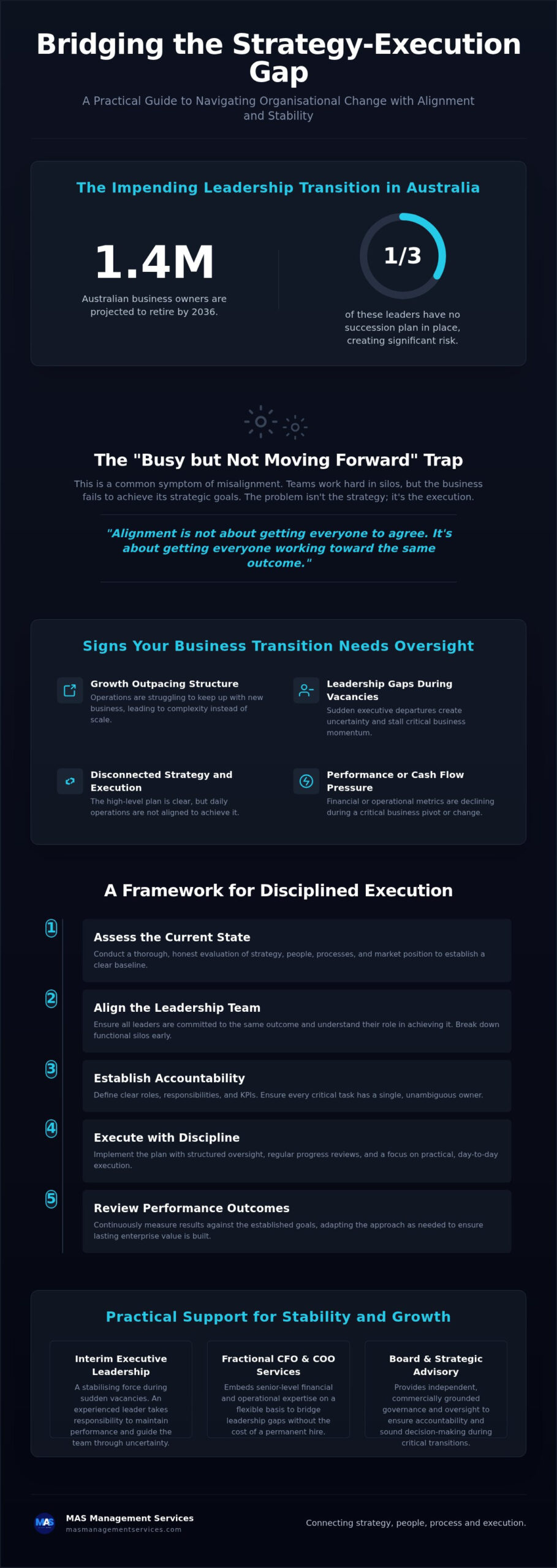
By 2036, 1.4 million Australian business owners will retire. Research shows one-third of these leaders have no succession plan in place. This creates a precarious environment for companies where growth is already outpacing structure. Effective business transition management is not a theoretical exercise. It’s a disciplined requirement for stability.
You know the frustration of the strategy-execution gap. Everyone is busy, yet the business isn’t moving forward. It’s a common symptom of leadership misalignment during periods of change. This guide explains how to navigate complex organisational shifts with a focus on accountability and practical execution. We’ll explore how to bridge the gap between high-level strategy and daily operations. You will learn to build lasting enterprise value by ensuring your team is working toward the same outcome. Stability is the goal. Practicality is the method.
Key Takeaways
- Understand why successful business transition management requires leadership alignment and practical execution over theoretical strategy.
- Discover how interim and fractional leadership provides the oversight needed to maintain stability during sudden executive vacancies.
- Implement a practical framework for organisational shifts by establishing role clarity and clear lines of accountability.
- Shift from one-off changes to a culture of performance through an independent, commercially grounded perspective.
Understanding Business Transition Management: Beyond the Strategy
Business transition management is the bridge between current operations and future goals. It’s more than a document. It’s a disciplined process of moving an organisation from one state to another without losing momentum. Most businesses have a strategy. Few have a practical roadmap for execution. This is where transitions often fail.
Change carries a heavy human weight. Leadership shifts cause uncertainty. Without oversight, the focus shifts from performance to survival. A successful transition doesn’t just address the mechanics of change management; it builds lasting enterprise value. It ensures the business is stronger after the shift than it was before. This requires a focus on governance and accountability.
The Alignment Challenge: Why Agreement Isn’t Enough
Recognising the Signs Your Transition Needs Oversight
Transitions often stall because the leadership structure cannot support the new reality. Leaders must be honest about their internal capacity. Watch for these signals:
- Growth is outpacing the current structure.
- Leadership gaps exist during vacancies.
- Strategy and execution are disconnected.
- Performance or cash-flow pressure emerges during a pivot.
- New market initiatives lack a dedicated executive lead.
When everyone is busy but progress is stalled, the issue is rarely the plan. It’s the execution. Practical, disciplined oversight ensures the roadmap is followed and outcomes are achieved.
Interim Executive Leadership: The Stabilising Force
Who runs the business when a CEO or CFO leaves suddenly? A vacancy at the top creates immediate risk. Momentum stalls. Uncertainty spreads. This is a critical juncture in business transition management. An advisor gives suggestions. A leader takes responsibility. Interim leadership provides the latter. Steadying the ship. Providing oversight. Maintaining performance while the permanent search continues. A seasoned executive providing calm in the storm.
Fractional CFO and COO Services
Fractional leadership offers a pragmatic solution. Embedding senior expertise on a part-time or fixed-term basis. It bridges the finance leadership gap. No permanent hire cost. Operational leadership on demand. A fractional COO focuses on stabilising the business under pressure. Ensuring day-to-day performance doesn’t suffer during a pivot. If you are navigating rapid change, interim leadership support provides the required stability.
Board and Strategic Advisory
Governance oversight is essential during critical phases. Independent support for owners facing major transactions. This ensures accountability. It’s not just advice. It’s building a foundation for better decision-making. Many organisations struggle without a commercially grounded perspective at the board level. Without this, efforts often stall. This lack of alignment is a primary reason Why Transformation Efforts Fail. Proper advisory keeps the focus on building lasting enterprise value. Managing the human weight of the transition. Practical support when it matters. Engaging independent board advisory services introduces the commercially grounded challenge required to bridge boardroom oversight and disciplined execution.
A Framework for Successful Transition: Alignment and Accountability
Business transition management requires a structured approach. It isn’t a single event. It’s a five-step process: assess the current state, align the leadership team, establish accountability, execute with discipline, and review the performance outcomes. Without this framework, growth creates complexity that eventually stalls the business. Structure must scale to match your ambition.
Accountability is the foundation of scale. When roles are blurred, progress stops. Business silos are the hidden cost of this confusion. Departments work in isolation. They become busy but don’t move the business forward. Breaking these silos requires aligning everyone around the customer and a single company outcome. It’s about turning complexity into sustainable performance.
Post-Merger Integration: When Two Become One
Leadership decisions matter most after an acquisition. The challenge is merging different ways of working. One company. One culture. One focus. Protecting enterprise value during this period requires firm oversight. Success depends on how quickly you align people and processes. Dedicated mergers and acquisitions leadership support ensures cultural alignment and disciplined execution protect the value promised at the deal stage. If you are preparing for a merger, book a business transition consultation to ensure a smooth integration.
Turning Strategy into Execution
Strategy is rarely the failure point. Execution is. Improving the operating model supports the new strategic direction. It requires disciplined daily operations and constant oversight. Role clarity is the structural antidote to transition confusion, ensuring every leader knows exactly what they are responsible for delivering. Practical, grounded leadership turns a theoretical plan into a commercial reality. This is how you build lasting value.
Building Better Businesses Through Practical Support
Effective business transition management moves beyond surviving a crisis. It establishes a culture of continuous performance. One-off changes don’t build lasting value. Enterprise value comes from disciplined execution and a clear roadmap. An independent, commercially grounded perspective provides the clarity needed for this shift. It removes the internal bias that often stalls progress. This perspective cuts through the noise of daily operations. It focuses on what truly moves the needle. It acknowledges the human weight of leadership shifts while maintaining a focus on outcomes. For organisations seeking to nurture leadership capability and foster team excellence through tailored programmes, visit Humanise Solutions.
The MAS Approach: Strategy, Leadership, Execution
Strategy. Leadership. Execution. This tagline defines our role as a practical operator. We connect high-level strategy to the people and processes that drive growth. We are facilitators. We don’t just advise from the outside; we step in and take responsibility. Our focus remains on results that build long-term enterprise value. We provide practical executive support when it matters most. This ensures your organisation remains stable during uncertain times. We bridge the gap between where you are and where you need to be.
Securing Your Leadership Continuity
Leadership continuity provides certainty for your team and stakeholders. It is the foundation of a stable organisation. Tailoring outsourcing solutions can reduce operational costs and increase efficiency. It embeds senior expertise exactly where it is needed most. Preparing for your next major milestone requires a clear, actionable roadmap. You must address leadership gaps before they become liabilities. To begin this process, Schedule a consultation to discuss your business transition with a seasoned executive. A free one-on-one consultation offers a professional, commercially grounded discussion about your specific challenges. Secure your leadership continuity today.
Securing Stability for the Road Ahead
Successful business transition management is more than a strategic plan. It requires the connection of people, processes, and execution. Stability comes from leadership alignment. Continuity comes from having the right oversight at the right time. You have explored how interim leadership acts as a stabilising force and how role clarity turns complexity into scale. These are not just theoretical concepts. They are the foundations of building lasting enterprise value.
MAS Management Services provides the experienced executive leadership needed for capability and continuity. Our focus is on practical, disciplined execution. We offer independent, commercially grounded support to help you navigate high-pressure shifts with confidence. This ensures your business remains resilient through every phase of growth. Book a Free 1-on-1 Consultation with MAS Management Services to discuss your specific transition requirements. Your organisation’s next chapter starts with a firm handshake and a clear roadmap. We are ready to step in when it matters most.
Frequently Asked Questions
What is the difference between transition management and change management?
Transition management is the bridge between current operations and a specific future-state goal, such as an ownership shift or merger. While change management often focuses on internal processes or culture, business transition management provides the practical executive oversight needed for continuity. It ensures the business remains stable while leadership changes occur. This approach prioritises accountability and disciplined execution to protect enterprise value during high-pressure organisational shifts.
How long does a typical business transition engagement last?
Engagement durations are tailored to the complexity of the organisational shift and the specific leadership gaps involved. An interim executive might provide oversight for several months while a permanent search is conducted. Other projects, such as restructuring or post-merger integration, last until defined performance milestones are achieved. The focus is always on delivering a stable, sustainable outcome rather than maintaining a permanent, long-term consulting presence.
When should we consider a fractional executive instead of a permanent hire?
You should consider a fractional executive when your organisation requires senior-level capability but cannot justify the cost of a full-time permanent hire. This is a pragmatic solution for businesses where growth has outpaced the current leadership structure. Fractional leaders provide the required oversight and accountability on a part-time basis. It is a flexible way to embed experienced leadership into your team during a strategic pivot or growth phase.
How does an interim leader manage existing staff during a restructuring?
An interim leader manages staff by providing a calm, objective presence that reduces uncertainty during periods of change. They focus on establishing role clarity so every team member understands their specific responsibilities. By taking a hands-on approach rather than just offering advice, they bridge the gap between people and process. This ensures that daily operations continue smoothly while the broader restructuring goals are being executed with discipline.
What are the most common risks during an ownership transition?
The most common risks include leadership gaps, loss of momentum, and a widening strategy-execution gap. Without disciplined business transition management, organisations often find that everyone is busy but progress has stalled. Misalignment during an ownership shift can quickly erode enterprise value. Engaging a structured ownership transition advisory helps mitigate these risks by ensuring that all leadership decisions are focused on long-term performance and clear accountability across the entire organisation.