
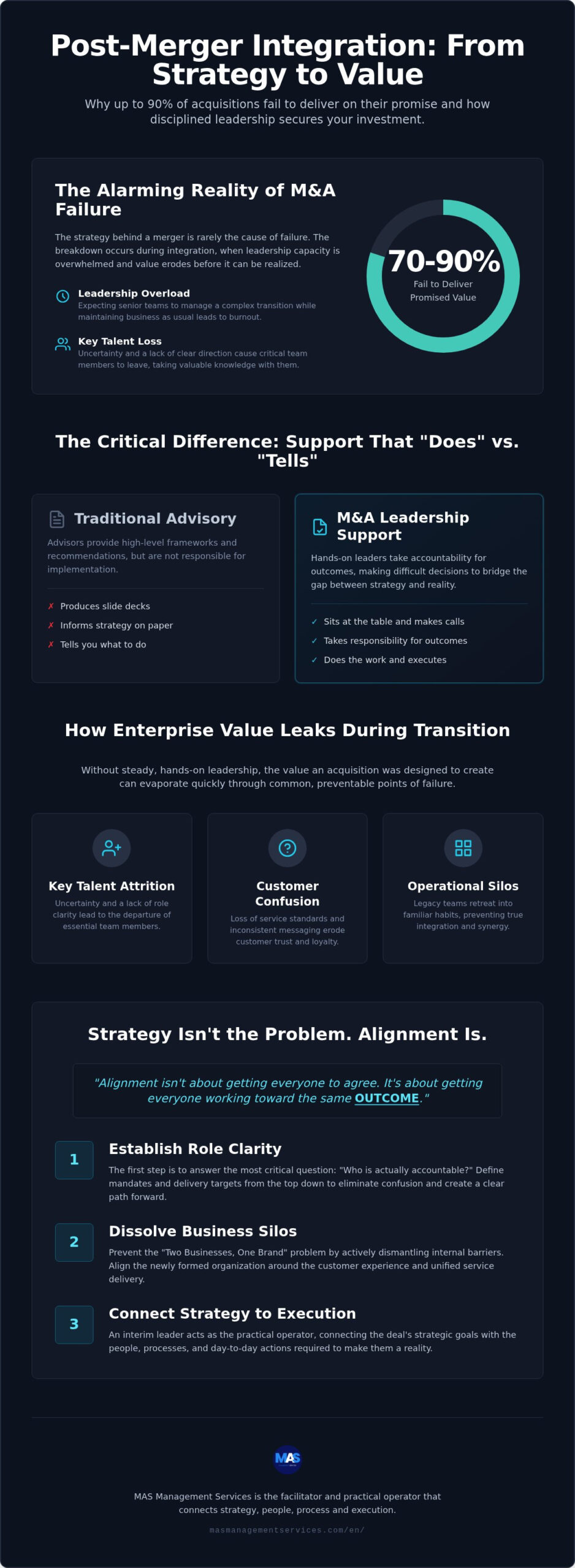
Between 70% and 90% of corporate marriages fail to deliver the value promised on the term sheet. The failure rarely stems from a poor strategy. It happens because the integration process lacks disciplined mergers and acquisitions leadership support. Your senior team is already at capacity. Expecting them to manage a complex transition while maintaining business as usual leads to burnout and key talent loss.
We understand the weight of these transitions. It’s a high-pressure period where cultural misalignment can quickly erode synergies. You need a stable transition period that moves beyond simple agreement toward genuine operational unity. This guide explores how interim leadership and practical alignment protect enterprise value. You’ll learn how to establish clear accountability across the new organisation. We provide a roadmap for connecting strategy, people, and execution. Realising deal value requires more than a signature. It requires a deliberate, hands-on approach to integration.
Key Takeaways
- Understand why standard management teams often struggle to balance daily operations with integration and how mergers and acquisitions leadership support provides the necessary executive capacity.
- Learn how independent interim leaders provide objective oversight and maintain accountability during the high-pressure transition period.
- Discover why true alignment is about driving toward shared outcomes rather than simple agreement, preventing the formation of costly business silos.
- Establish a practical framework for connecting strategy with execution to ensure the synergies promised in the deal are actually realised.
What Is Merger and Acquisition Leadership Support?
Merger and acquisition leadership support provides experienced, hands-on executive capability during a deal and its aftermath. It’s a pragmatic solution for boards. Most Mergers and acquisitions (M&A) fail because leadership teams are stretched too thin. They are forced to manage “business as usual” while simultaneously integrating a new entity. This creates a performance vacuum. Practical support fills this void by providing steady oversight and continuity.
The distinction between advisory and leadership support is critical. Advisors tell. They produce slide decks and high-level frameworks. Leadership support does. It involves sitting at the table, making difficult calls, and taking responsibility for the outcome. It is the bridge between a strategy on paper and operational reality.
The Critical Need for Transition Leadership
A leadership gap often emerges when a CEO or board focuses entirely on the transaction. Navigating complex deal elements, such as structuring debt versus equity financing (find out more), consumes immense executive bandwidth. The core operation loses focus. Performance dips. Interim executives provide the steady hands required to maintain performance during periods of high uncertainty. They manage the friction of change. This allows the permanent team to remain focused on the future state. Effective mergers and acquisitions leadership support ensures the business doesn’t stall while the deal closes.
Protecting Enterprise Value from Day One
Value erosion happens quickly. Common points of leakage include:
- Key talent attrition due to uncertainty.
- Customer confusion and loss of service standards.
- The emergence of operational silos.
Leadership support acts as a safeguard against these risks by establishing clear accountability and maintaining operational momentum. It protects the enterprise value that the deal was designed to create. For businesses navigating a change in ownership, structured ownership transition advisory provides an additional layer of protection, ensuring the business remains a stable, high-performing asset throughout the handover.
The Role of Interim Executives in Post-Merger Integration
Integration is the point where deal value is captured or permanently lost. An interim CEO or COO provides the dedicated focus required during this high-stakes phase. Unlike permanent executives, these leaders offer unbiased oversight. They aren’t hindered by legacy politics or internal history. Their objective is the success of the new entity. They bring a fresh perspective to governance and performance.
The most critical question in any merger is: “Who is actually accountable?” Without role clarity, integration projects stall. Interim executives establish this accountability early. They define the operating model. They ensure every department lead knows their specific delivery targets. This structure allows the business to scale rather than collapsing under new complexity.
Bridging the Gap Between Strategy and Execution
Most organisations don’t fail because the strategy was flawed. They fail because execution is misaligned. An interim leader takes practical steps to stabilise the business in transition. This involves reviewing cash flow, identifying process bottlenecks, and conducting performance reviews. They act as the practical operator. They connect strategy, people, and process. If you need a partner to manage these complexities, consider a free 1-on-1 consultation to discuss your requirements.
Fractional Leadership: A Flexible Model for M&A
Accessing senior expertise doesn’t require a permanent hire. The fractional executive retainer model offers a cost-effective way to secure high-level mergers and acquisitions leadership support. This flexibility is essential for boards managing tight integration timelines. It provides immediate capability without long-term overhead. For more insights on managing change, refer to our Business Transition Guide for Australian Leaders. It provides a clear framework for maintaining stability during rapid growth.
Strategy Isn’t the Problem: Five Steps to Alignment
Alignment isn’t about getting everyone to agree. Agreement is passive and often hides underlying friction. True alignment is active. It’s about ensuring every team member works toward the same outcome. Following an acquisition, many organisations suffer from the “Hidden Cost of Business Silos.” Legacy teams retreat into familiar habits. This results in “Two Businesses” operating under a single brand. To realise the deal’s potential, you must align around the customer. This shift requires professional mergers and acquisitions leadership support to dismantle internal barriers and focus on service delivery. When the business must also reposition itself in the market, applying strategic pivot leadership principles can help align people, process, and purpose to secure enterprise value through the transition.
Step-by-Step Alignment Framework
Effective integration relies on a structured approach to unity. This framework provides the necessary rigour:
- 1. Establish role clarity: Define accountability from the top down so every leader knows their specific mandate.
- 2. Dissolve silos: Identify where information flow has stalled and force cross-functional collaboration.
- 3. Align processes: Standardise operating models to support the increased scale of the new entity.
- 4. Optimise resources: Incorporate specialized services like Mowing Route Density to ensure that essential operational equipment is readily available as the business scales.
This process moves the business from fragmented departments to a single, high-performing organisation.
Growth Creates Complexity; Alignment Turns It Into Scale
Growth is a double-edged sword. It brings opportunity but also creates significant complexity. As headcount grows and geographic footprints expand, you risk having “One Company, Five Ways of Working.” This fragmentation kills efficiency. Alignment acts as the facilitator that connects people, process, and execution. It ensures that as you grow, you actually scale. Practical mergers and acquisitions leadership support provides the external oversight needed to maintain this discipline. If your business feels busy but isn’t moving forward, book a consultation with MAS Management Services to align your strategy with your operations.
Securing Your Transition with MAS Management Services
MAS Management Services provides the practical, disciplined executive support required to navigate complex transitions. We serve Australian boards and business owners who need more than high-level advice. They need execution. Our approach is commercially grounded and independent. We don’t just observe from the sidelines. We step in and take responsibility for the outcome. This specialised mergers and acquisitions leadership support ensures that the strategic intent of a deal translates into measurable operational performance. We act as the bridge between the board’s vision and the team’s daily output.
Our core offerings include:
- Interim & Fractional Leadership
- Business Transition
- Restructuring & Recovery
- Board & Advisory
Practical Executive Support When It Matters
We work alongside your existing management team. We don’t replace them. We strengthen them. Transitions often stretch internal capacity to the breaking point. We provide the additional capability needed to maintain momentum during periods of high uncertainty. Our focus is on building lasting enterprise value. We look past short-term fixes to establish robust operating models and clear accountability. As an independent partner, we provide unbiased oversight. This allows the board to receive an accurate, unvarnished view of the integration progress.
Take the Next Step Toward Alignment
Alignment is the difference between a deal that looks good on paper and one that delivers in reality. It is the facilitator that connects your people, processes, and execution. Without it, value erodes through silos and talent loss. With it, complexity turns into scale. Securing your deal value starts with a clear-eyed assessment of your specific transition needs. We invite you to book a free 1-on-1 consultation to discuss how we can support your organisation through its next phase of growth. Let’s ensure your transition is stable, disciplined, and successful.
Securing Your Enterprise Value Through Alignment
Successful integration requires moving beyond the term sheet. It demands a shift from two separate entities to one aligned business focused on the customer. Alignment turns complexity into scale by connecting strategy with execution. Independent oversight ensures that accountability remains clear during high-pressure transitions. You can’t leave the outcome to chance or an overstretched management team.
Securing these outcomes requires dedicated mergers and acquisitions leadership support. MAS Management Services provides experienced executive leadership for additional capability and oversight. Our support is commercially grounded and focused on building lasting enterprise value through practical, disciplined execution. When the direction of the business must shift alongside the integration, the principles of strategic pivot leadership ensure that alignment of people, process, and purpose is maintained throughout the transformation. We act as the facilitator between your vision and the operational reality. Where a change in ownership is also part of the equation, our ownership transition advisory services ensure that leadership shifts do not undermine the operational momentum you have worked to build.
Take the first step toward a stable transition and realised synergies. Book a free 1-on-1 consultation with MAS Management Services to discuss your specific requirements. Better businesses are built through deliberate, hands-on action. You have the strategy. We provide the stability to see it through.
Frequently Asked Questions
What is merger and acquisition leadership support?
Merger and acquisition leadership support provides boards and owners with experienced executive capability to manage a deal and its aftermath. It involves embedding a senior leader within the organisation to turn strategy into execution. This hands-on support focuses on improving operating models and accountability. Unlike passive advice, it provides the steady oversight required to protect enterprise value during high-pressure transitions while the permanent management team maintains daily operations.
How does an interim executive help during post-merger integration?
An interim executive provides independent, commercially grounded oversight during the critical integration phase. They bridge the gap between paper strategy and operational reality by stabilising the business and identifying process bottlenecks. By establishing role clarity and accountability, they prevent the formation of costly business silos. This dedicated mergers and acquisitions leadership support allows the new entity to scale effectively while ensuring that synergies promised during the deal are actually realised.
What is the difference between M&A consulting and leadership support?
The primary difference lies in execution versus advisory. M&A consulting typically focuses on high-level strategy, financial modelling, and cultural diagnostics. Leadership support involves the practical application of these strategies by an embedded executive who takes responsibility for outcomes. While consultants often produce frameworks and then depart, leadership support provides the “steady hands” required to manage the daily friction of change and ensure that processes are standardised across the organisation.
When should a board consider hiring an interim CEO for a merger?
A board should consider an interim CEO when the current leadership team is stretched too thin to manage both integration and core operations. This often occurs when performance or cash-flow pressures emerge during the transition. Hiring an interim leader provides additional capability and independent oversight. It is effective when a deal involves entering new markets or managing a headcount that has outpaced the existing structure’s ability to govern.
How do you align two different company cultures after an acquisition?
Cultural alignment is achieved by getting everyone to work toward the same outcome rather than seeking simple agreement. It involves aligning the organisation around the customer and standardising ways of working. Professional mergers and acquisitions leadership support facilitates this by establishing role clarity and dissolving internal silos. By focusing on shared performance targets and a single operating model, the business moves from two separate entities to one unified organisation.