
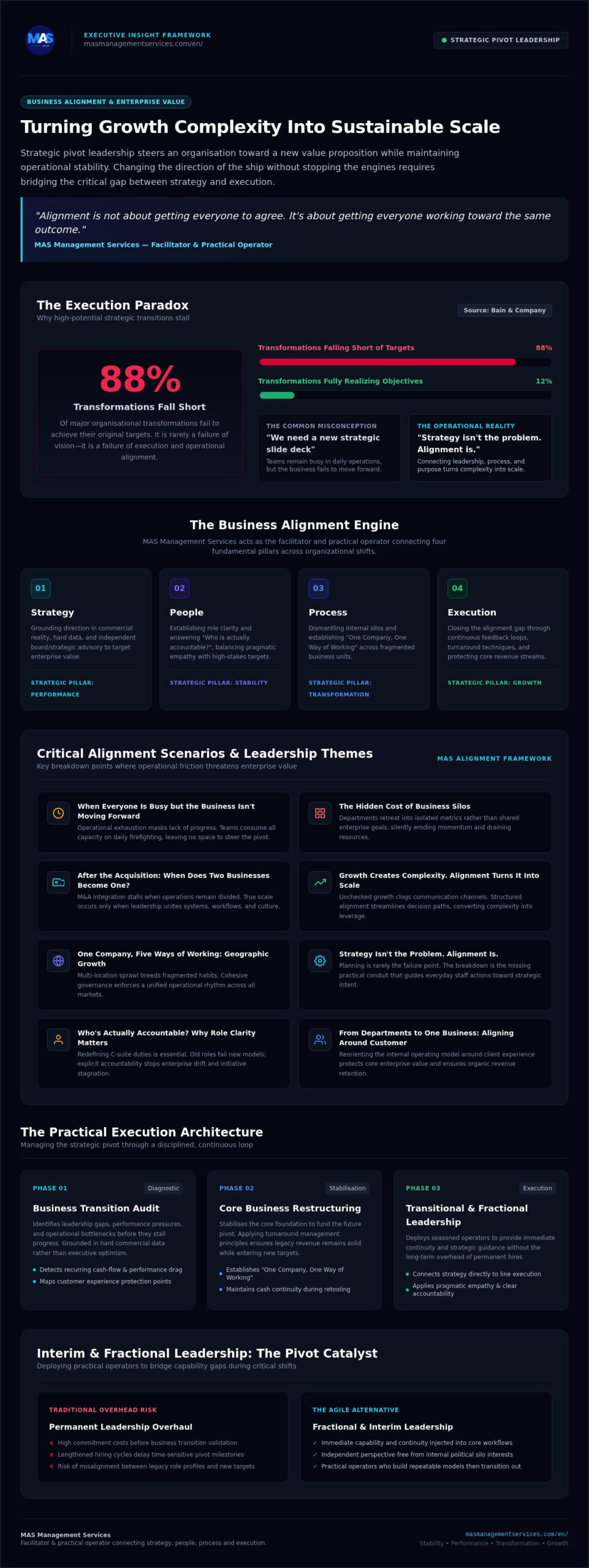
Research shows that 88% of major organisational transformations fall short of their original targets. It isn’t usually a failure of vision. It’s a failure of execution. Strategic pivot leadership requires more than a new slide deck. It demands the alignment of people, process, and purpose to secure enterprise value. Most leaders eventually find that strategy isn’t the problem. Alignment is.
You likely recognise the tension. Perhaps your current growth has outpaced your leadership structure. Your teams are busy, but the business isn’t moving forward. They’re consumed by daily operations, leaving no room to lead a pivot. It’s a common state where the hidden cost of business silos begins to erode your momentum. The weight of transition can feel overwhelming when internal resources are already stretched thin.
Leading a successful transition doesn’t mean getting everyone to agree. It means getting everyone working toward the same outcome. This guide provides a clear framework to align your business around a new direction. We’ll explore how interim and fractional leadership provides the capability and continuity needed to maintain stability. You’ll learn to turn complexity into scale by connecting strategy directly to execution.
Key Takeaways
- Effective strategic pivot leadership ensures every process and person aligns with the new value proposition. This focus maintains operational stability during change.
- Role clarity prevents internal silos. Identifying who is actually accountable for specific outcomes is the most critical step in any business transition.
- A transition audit identifies leadership gaps before they stall progress. Aligning the internal shift with the customer experience protects your enterprise value.
- Interim and fractional leadership provides immediate capability and continuity. Practical operators connect strategy to execution without the long-term cost of permanent hires.
What is Strategic Pivot Leadership?
Strategic pivot leadership is the ability to steer an organisation toward a new value proposition while maintaining operational stability. It is a delicate balance. You must change the direction of the ship without stopping the engines. Most pivots fail. Research from Bain & Company indicates that 88% of transformations fall short of their original targets. This is rarely due to a poor plan. It is usually a lack of alignment across the business.
Alignment is not about getting everyone to agree. It’s about getting everyone working toward the same outcome. This requires transitional leadership to bridge the gap between the current state and the future vision. When the link between strategy and execution breaks, the business loses momentum. A seasoned leader steps in to reconnect these elements, ensuring every resource is focused on the new objective.
Strategy vs. Execution: The Alignment Gap
A brilliant strategy fails without a practical execution model. Strategy isn’t the problem. Alignment is. As a business expands, growth creates complexity. This complexity often slows decision-making and creates internal friction. Alignment turns that complexity into scale. It ensures every department supports the central enterprise value. This involves applying turnaround management principles to stabilise the core while pursuing new market opportunities. It’s about moving from departments to one business.
Recognising the Need for a Pivot
Success requires knowing when the current path is exhausted. You might see consistent performance pressure or recurring cash-flow issues. Often, teams are busy but the business isn’t moving forward. A strategic pivot is a fundamental shift in business model or market focus to build enterprise value. Recognising these signs early allows for a controlled transition—organisations evaluating new commercial horizons can read more about strategic consulting support. It prevents the need for drastic recovery measures later. Practical strategic pivot leadership identifies these gaps and implements the necessary capability and continuity to move forward.
The Mechanics of Successful Pivot Leadership
Successful strategic pivot leadership relies on operational precision. Vision is the starting point, but execution requires a framework. The most critical question during any shift is: “Who is actually accountable?”. Without role clarity, new initiatives stall. Departments often retreat into silos, protecting their own metrics instead of the enterprise goal. This is the hidden cost of business silos. It erodes momentum and creates internal friction that a business in transition cannot afford.
Leadership must look beyond executive optimism. It involves recognising the need to pivot based on hard data and market reality. Board and strategic advisory provide the independent oversight necessary to keep the transition commercially grounded. This external perspective ensures that the pivot remains focused on long-term enterprise value rather than short-term reactions.
Role Clarity and Accountability
Redefining C-suite responsibilities is essential when the business model changes. Old roles may no longer fit the new direction. Leaders must apply pragmatic empathy. They must acknowledge the human weight of change while remaining firm on performance requirements. This balance ensures that teams feel supported but understand the high stakes involved. Clarity in accountability stops the business from drifting. The same principle applies when combining two organisations, where post-merger integration leadership must establish blended accountability structures to prevent value leakage.
Stabilising the Core During Change
A pivot is not a total abandonment of the past. You must stabilise the core business to fund the future. This requires specific restructuring and recovery techniques to protect existing revenue streams. Diverting resources to a new direction is risky if the foundation is crumbling. Engaging fractional leadership provides the necessary oversight to maintain performance during this transition. Adopting a “One Company, One Way of Working” philosophy prevents fragmentation. Effective strategic pivot leadership ensures the business remains viable while the transformation takes hold.
How to Lead a Pivot: A Practical Execution Framework
Practical execution requires a structured approach. It begins with a comprehensive Business Transition audit. This diagnostic identifies leadership gaps, performance pressures, and operational bottlenecks that might stall progress. For organizations expanding into government sectors, The GovCon Architect provides the strategic consulting required to navigate federal contracting. Effective strategic pivot leadership treats strategy, leadership, and execution as a single, continuous loop. If one link fails, the entire shift collapses. A disciplined execution model ensures that every tactical move supports the long-term goal of building enterprise value.
The 90-Day Pivot Roadmap
Success is often determined in the first three months. A 90-day roadmap provides the necessary structure to manage high-stakes change without losing momentum. The process follows three distinct phases:
- Phase 1: Diagnosis and Stabilisation. You must secure cash flow and stabilise mission-critical operations. This prevents the business from fracturing while you prepare for the shift.
- Phase 2: Alignment. This phase focuses on getting everyone working toward the same outcome. It involves aligning people, processes, and governance to the new strategic direction.
- Phase 3: Execution and Scaling. Once the foundation is stable, the focus shifts to scaling the new model and embedding it into daily operations.
Communicating the Shift
Communication is the bridge between strategy and buy-in. Messaging must move the organisation from “Departments” to “One Business”. This transition is achieved by aligning everyone around the customer. When teams understand how the pivot improves the customer experience, they find purpose in the change. Internal messaging builds trust with staff, while external communication maintains confidence with the board and stakeholders. Clear governance oversight and regular milestone reporting keep the transition on track. If you’re navigating a high-stakes shift, a Free 1-on-1 Consultation can help clarify your execution roadmap.
Interim and Fractional Leadership: The Pivot Catalyst
Interim and fractional executives act as a catalyst for change. They provide the capability and continuity required when an organisation must shift direction. This model offers immediate impact without the long-term cost or commitment of a permanent hire. It’s practical executive support. These are leaders who have sat at the board table. They’ve made the difficult calls. They bring an objective perspective to high-stakes decisions that internal teams might miss due to proximity or bias.
Bridging the Leadership Gap
Existing management teams are often consumed by daily operations. They’re busy, but the business isn’t moving forward. Using an interim CEO or COO allows the business to maintain operational momentum while the owner focuses on the long-term vision. This reduces the burden on internal staff who may lack the specific experience required for a transition. A fractional executive retainer is a cost-effective solution for SMEs navigating growth. It provides high-level expertise on a flexible basis. This independent support is vital for owners and boards facing complex strategic pivot leadership challenges. It ensures that strategy, people, and processes remain aligned throughout the transition.
Building Lasting Enterprise Value
Transitional leadership does more than manage a shift. It leaves the business stronger. It embeds better governance, role clarity, and improved accountability. These structural improvements ensure the business is organised for scale. The goal is always to build lasting enterprise value. Effective strategic pivot leadership ensures the new model is sustainable and profitable. For those managing broader ownership changes, our Business Transition Guide for Australian Leaders provides deeper context on navigating these shifts. Practical oversight ensures your business remains stable during high-pressure periods, turning a difficult pivot into a platform for future performance.
Securing Long-Term Enterprise Value
A successful transition requires more than a shift in strategy. It demands a fundamental alignment of your people, processes, and governance. Effective strategic pivot leadership ensures that the entire organisation moves toward a single outcome, rather than retreating into silos. By establishing clear accountability and role clarity, you turn complexity into scale. This practical approach protects your current performance while you build for the future.
Transitional leadership provides the capability and continuity needed during these high-stakes periods. Having a seasoned executive who has sat at the board table makes the difference. MAS Management Services offers practical, commercially grounded support to connect your strategy to execution. Our focus is on building lasting value through experienced leadership. If you’re ready to align your business for the next phase, book a free 1-on-1 consultation with a MAS executive advisor to discuss your strategic pivot. You can lead your organisation through change with confidence and stability.
Frequently Asked Questions
What is the difference between a strategic pivot and a business restructuring?
A strategic pivot is a fundamental shift in business model or market focus to build enterprise value. Restructuring focuses on financial or operational recovery for businesses in distress. While a pivot changes the organisation’s direction, restructuring often stabilises the existing core. Both require experienced leadership to manage transition and ensure the business remains viable while the transformation takes place.
How long does a typical strategic pivot take to execute?
Execution timelines vary based on the complexity of the organisation. A structured 90-day roadmap typically covers initial diagnosis and stabilisation. However, embedding the new model and scaling operations often takes six to twelve months. Strategic pivot leadership focuses on achieving measurable milestones during this period. Long-term success depends on how quickly the leadership can align people and processes to the new direction.
Why is alignment more important than the strategy itself during a pivot?
Strategy defines the destination, but alignment drives the business toward it. Most shifts fail because execution is ignored. Alignment is not about getting everyone to agree; it’s about getting everyone working toward the same outcome. Effective strategic pivot leadership bridges this gap by ensuring every department supports the central enterprise goal. This prevents silos and ensures the business model shift actually takes hold.
When should a business consider hiring an interim executive to lead a pivot?
Engage an interim executive when internal management is at capacity or lacks the specific experience for a major shift. These practical operators provide additional capability and steady oversight during high-stakes transitions. They help bridge the leadership gap, allowing owners to focus on long-term vision. An interim leader brings an objective, commercially grounded perspective that is vital for making difficult calls and securing enterprise value. This expertise is equally critical when navigating the complexities of post-merger integration leadership, where operational silos and blurred accountability can quickly erode deal value.
How do you maintain staff morale and retention during a major strategic shift?
Transparency and role clarity are the foundations of morale. Staff need to understand who is actually accountable and how their roles change. Applying pragmatic empathy allows leaders to support teams while maintaining performance standards. By aligning the internal shift with the customer experience, you provide a clear purpose. Constant communication about milestones and governance builds trust and helps retain key talent during the transition.