
The governance structure designed to protect your enterprise might actually be stalling its execution. When businesses navigate growth or major transition, leaders often struggle to balance statutory liabilities with practical commercial guidance. Engaging the right non-executive director advisory support determines whether high-level strategy translates into operational reality or remains trapped in boardroom discussions.
You already recognise the frustration of watching clear board directives lose momentum across departmental silos. Strategy isn’t the problem; practical alignment is. Alignment isn’t about forcing consensus across the table. It’s about establishing role clarity and getting every division moving toward the same commercial outcome.
In this guide, you’ll understand the core distinctions between statutory non-executive directors and strategic board advisors so you can separate legal oversight from advisory flexibility. We examine a practical governance framework designed to connect executive management with board-level strategy, turning high-level planning into disciplined execution and enterprise value.
Key Takeaways
- Distinguish between statutory oversight and flexible advisory roles to protect the business while maintaining strategic agility.
- Understand how non-executive director advisory support bridges the costly divide between high-level board vision and operational execution.
- Resolve departmental friction by establishing unambiguous role clarity and focusing cross-functional teams on singular commercial outcomes.
- Deploy a disciplined framework to scope, onboard, and leverage independent board guidance through periods of transition and growth.
What Is Non-Executive Director Advisory and How Does It Operate?
Effective governance requires a clear separation of duties. Operational management runs the daily business. Executive leadership delivers functional targets. Meanwhile, non-executive director advisory provides an objective vantage point, testing board assumptions without becoming entangled in daily firefighting.
The Statutory Mandate and Fiduciary Governance
Statutory directors hold formal voting power and carry legal exposure. By definition, an appointed Non-Executive Director operates under binding fiduciary duties. They carry legal responsibility for organisational solvency, financial reporting integrity, and operational risk oversight. Their mandate is absolute: protect the organisation, safeguard shareholder interests, and verify that statutory standards are met.
Independent Advisory as an Agile Strategic Counterpart
Independent advisory structures offer strategic agility without statutory encumbrance. An advisory specialist contributes commercial acumen, industry foresight, and operational diagnostics without holding voting rights or director liabilities.
This distinction changes the boardroom dynamic. Strategic advisors can challenge internal assumptions freely, address departmental friction, and mentor executives through complex business changes. Through targeted non-executive director advisory engagements, organisations secure senior executive guidance that accelerates execution while leaving statutory governance undisturbed.
Non-Executive Director vs Board Advisor: Evaluating the Governance Models
Statutory Accountability Versus Strategic Advisory Freedom
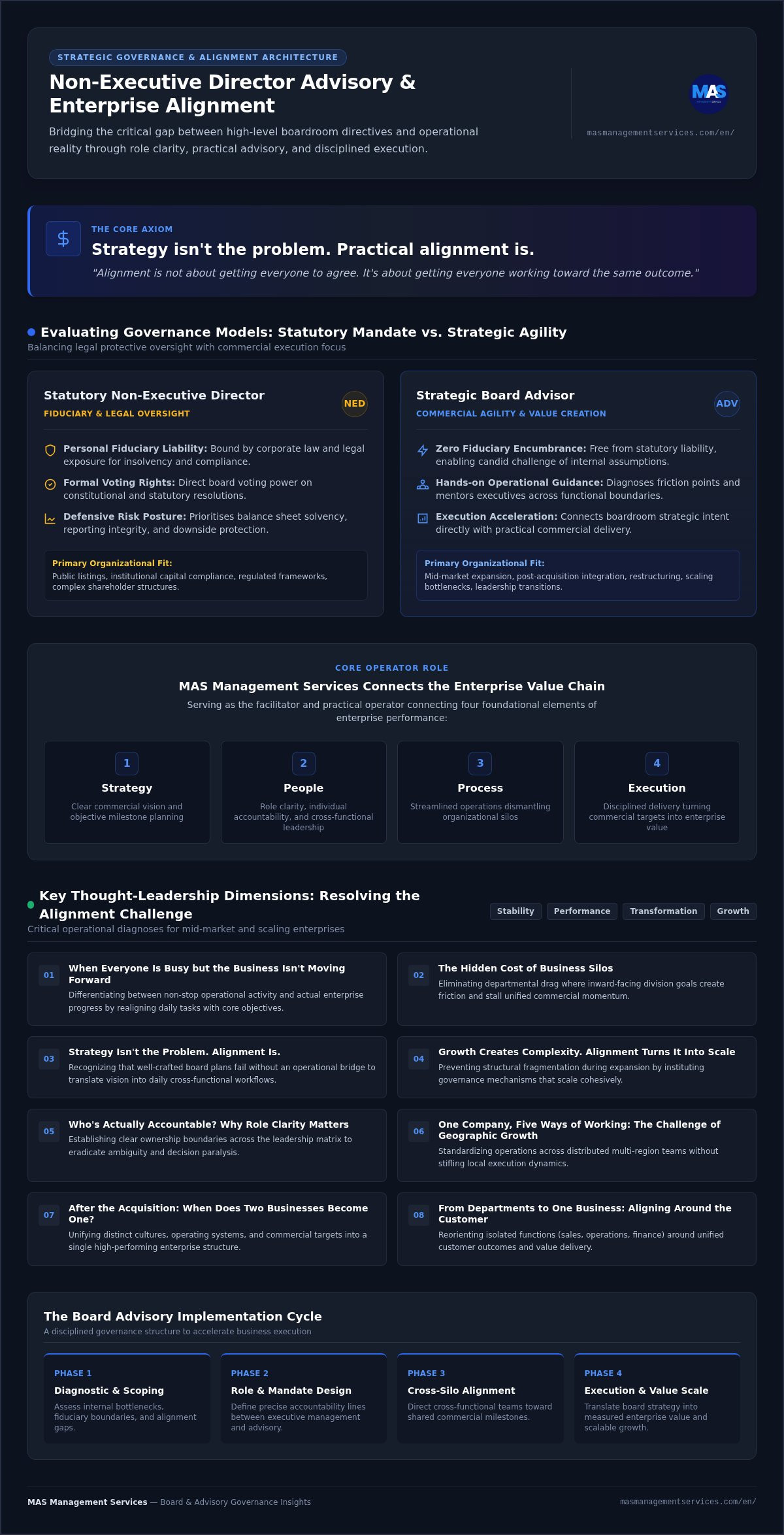
Statutory directors carry personal liability under corporate law. Their perspective naturally prioritises regulatory defence, balance sheet solvency, and risk mitigation. Strategic board advisors, however, operate without fiduciary voting encumbrance. This independence allows them to diagnose internal operational roadblocks and challenge executive assumptions candidly. As published research on strategic guidance for non-executive directors emphasises, governance must balance protective oversight with value creation; advisory structures deliver that commercial focus rapidly.
Matching Governance Structure to Organizational Maturity
The right model depends entirely on business maturity, ownership structure, and current operational risk:
- Statutory NEDs: Critical when meeting listing requirements, answering to institutional capital, or resolving complex shareholder voting rights.
- Board Advisors: Practical when navigating acquisitions, operational restructuring, or scaling bottlenecks that demand hands-on guidance.
Advisory models provide high flexibility. They allow owners to secure specialised capability precisely when required. For leadership teams navigating pivotal operational shifts, engaging practical Board & Advisory support establishes clear role accountability and accelerates strategic execution.
Driving Enterprise Alignment Through Strategic Board Guidance
Strategy isn’t the problem; alignment is. When an enterprise scales, growth naturally introduces complexity. Executive teams often retreat into departmental silos, focusing inward rather than outward. Everyone stays busy, but the business fails to move forward. Alignment isn’t about getting everyone to agree. It’s about getting everyone working toward the same commercial outcome.
Overcoming Operational Silos at the Executive Level
Business silos create hidden, compounding drag on enterprise performance. Sales pursues rapid volume. Operations defends delivery capacity. Finance restricts working capital. Without objective intervention, these conflicting priorities generate friction during major business changes.
Targeted non-executive director advisory dismantles these barriers. An experienced advisor steps in as a practical operator who connects strategy, people, process, and execution. By focusing leadership on shared milestones rather than insulated divisional targets, advisory support turns fragmented executive effort into disciplined commercial scale.
Clarifying Accountability Between the Board and Management
Effective governance demands unambiguous role clarity. Boards set strategic direction and evaluate risk; executive management delivers operational outcomes. When these lines blur, governance falters. Directors start micromanaging daily decisions, or management operates without rigorous performance benchmarks.
Independent non-executive director advisory establishes clear boundaries and transparent reporting. It ensures every executive knows who is actually accountable for each strategic deliverable. Organisations looking to build this accountability into their growth trajectory will find that corporate governance advisory connects board-level direction with operational execution, reducing bureaucracy while strengthening oversight. To resolve executive friction and strengthen your governance structure, schedule a Free 1-on-1 Consultation with MAS Management Services today.
Implementing Board Advisory Support to Accelerate Business Execution
Engaging advisory leadership must be deliberate. Mid-market companies frequently stumble by onboarding advisors based on personal networks rather than operational necessity. To drive real enterprise value, non-executive director advisory should be scoped around defined commercial challenges, structural transformations, or operational recovery.
High-stakes inflection points demand hands-on guidance. When managing ownership handovers, restructuring balance sheets, or executing mergers, review this business transition guide for Australian leaders to navigate ownership and structural change. The objective is to embed independent executive experience directly where internal capability is stretched.
Identifying Strategic Gaps and Capability Deficits
Scoping begins with a frank internal audit. Leadership must identify where execution stalls:
- Capability gaps: Unfamiliarity with debt restructuring, integrations, or international expansion.
- Operational inertia: Cross-functional friction delaying product rollouts or commercial initiatives.
- Governance blind spots: Inadequate performance tracking between the executive suite and owners.
Pinpointing these deficits ensures advisory appointments solve specific operational problems rather than generating general discussion. Smaller organisations often assume these challenges don’t apply to them, but understanding strategic oversight for SMEs and why business size does not exempt you from structured governance is a critical step toward sustainable scale.
Establishing Cadence, Reporting, and Practical Milestones
Governance fails when advisory sessions become passive debriefs. Effective non-executive director advisory demands a disciplined rhythm centred on execution. Establish a regular operating cadence with structured milestone tracking. Meetings should interrogate commercial metrics, remove cross-departmental bottlenecks, and hold managers accountable for agreed outcomes.
Independent advisors act as practical facilitators. They link high-level decisions to functional accountability, verifying that board priorities translate into measurable operational progress across the entire organisation.
Bridging Governance and Execution for Lasting Enterprise Value
Strong governance isn’t measured by regulatory compliance alone. It’s proven when high-level board vision translates directly into operational results. Choosing the right non-executive director advisory structure gives your business absolute clarity, separating legal oversight from flexible commercial counsel. When departmental silos dissolve and leaders commit to shared outcomes, strategic intent becomes sustainable enterprise value.
MAS Management Services operates as a practical executive partner connecting strategy, people, process, and execution. Whether navigating complex ownership transitions, financial restructuring, or steady commercial expansion, we deliver hands-on guidance tailored to owners, directors, and executive teams. Schedule a consultation with MAS Management Services to strengthen your board oversight and leadership execution. With clear accountability in place, your leadership team can move forward with confidence and control.
Frequently Asked Questions
What is the primary difference between a non-executive director and a board advisor?
The primary difference centres on legal authority and statutory liability. A non-executive director holds a formal seat on the board, possesses voting power, and carries fiduciary liability for corporate oversight. Conversely, non-executive director advisory professionals operate without statutory exposure or voting rights. They provide independent commercial guidance, test executive assumptions, and help leadership teams solve operational challenges without adding governance friction.
Can an SME or mid-market business benefit from board advisory without a formal board?
Yes, growing businesses often gain substantial traction from advisory support without establishing a formal statutory board. A practical advisory structure gives founders and executive teams access to seasoned leadership for strategic planning, operational recovery, and ownership transitions. This arrangement introduces executive accountability and fresh perspective while avoiding the administrative burden, regulatory compliance, and rigid fiduciary exposure of a formal governance framework. Founders questioning whether structured oversight applies to their scale will find that strategic oversight for SMEs is essential regardless of business size, delivering proportionate controls without unnecessary complexity.
How does strategic board advisory improve cross-departmental alignment?
Strategic advisory eliminates operational silos by establishing singular commercial priorities across functional leadership tiers. Departmental leaders frequently pursue conflicting targets, creating internal friction during periods of change. An external advisor provides objective oversight, clarifying roles and connecting strategy directly to execution. Instead of managing consensus, they ensure sales, operations, and finance work together toward identical enterprise outcomes.
Does a board advisor carry legal or statutory liability under corporate regulations?
No, board advisors do not hold statutory liability or legal duties under corporate regulations, provided they maintain an advisory capacity. Because they don’t vote on board resolutions or act as de facto directors, their focus remains purely commercial. This freedom allows non-executive director advisory specialists to challenge management thinking directly, offering candid, pragmatic counsel without the defensive caution that statutory oversight often creates.
How do organizations structure engagements for ongoing board and strategic advisory?
Engagements are typically structured around scheduled meeting cadences and defined strategic milestones. Organisations engage advisory leadership on an ongoing retainer or project basis tailored to critical inflection points like restructuring, scaling, or business transitions. Scopes define clear operational deliverables, reporting expectations, and regular reviews, ensuring the advisor acts as a hands-on sounding board focused on driving tangible enterprise value rather than administrative reporting.