
Strategic oversight is not corporate overhead. It is enterprise insurance. When daily operations consume your focus, stepping back feels like an impossible luxury. It is easy to view governance as bureaucratic red tape meant only for listed corporations with deep pockets. Yet, establishing practical strategic oversight for SMEs is often the critical shift that separates reactive survival from sustainable, resilient scale.
Most leaders recognise the strain when growth begins to outstrip existing operating capacity. You find yourself trapped in execution, lacking an objective sounding board for critical decisions. True alignment isn’t about consensus or getting everyone to agree; it is about ensuring every person and process works toward the same commercial outcome.
In this guide, you will discover why business size does not exempt you from structured governance, and how practical oversight builds enduring enterprise value. We examine how to implement proportionate controls, maintain operational agility, and protect your organisation against preventable blind spots.
Key Takeaways
- Practical strategic oversight for SMEs bridges high-level vision and operational execution, functioning as essential enterprise protection rather than administrative overhead.
- True business alignment is never about achieving universal agreement; it requires directing people, processes, and resources toward the exact same commercial outcomes.
- A proportionate governance framework separates strategic mandates from daily operational firefighting without introducing cumbersome corporate bureaucracy.
- Recurring execution bottlenecks, unclear accountabilities, and margin erosion are distinct signals that your business has outgrown informal steering and requires external advisory support.
The Big Myth: Why Strategic Oversight Is Not Just for Large Corporations
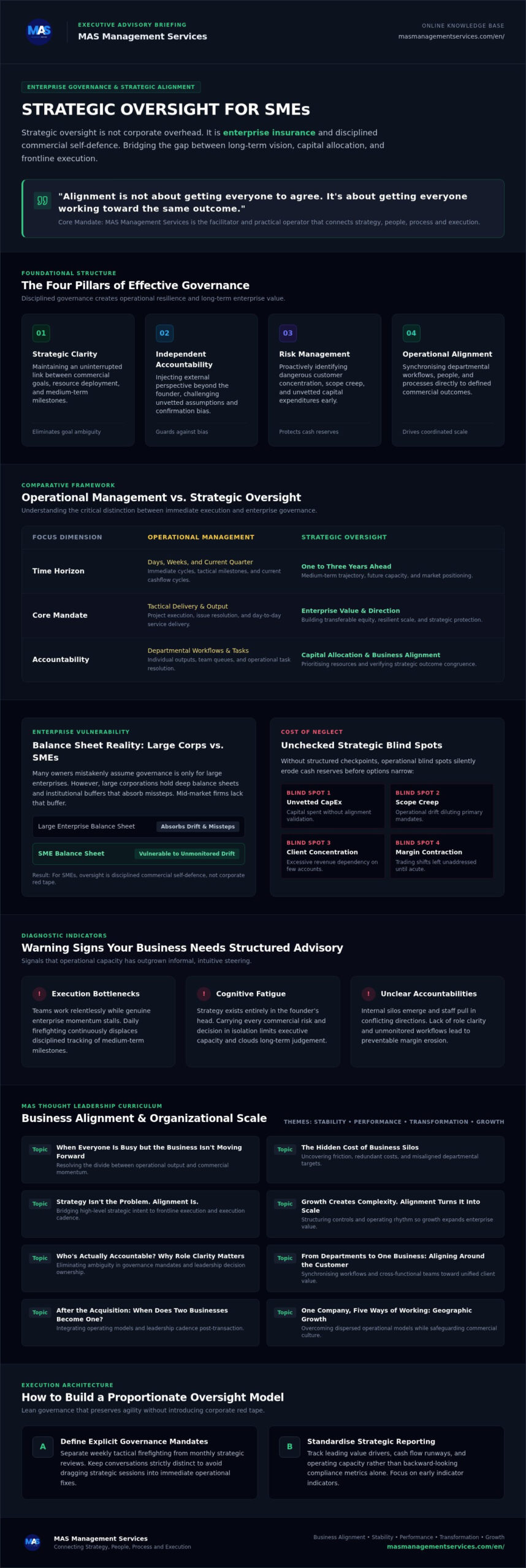
Many owners assume structured oversight belongs exclusively to public boardrooms. They view corporate governance as slow, paper-heavy compliance designed for multinationals. That assumption is a dangerous commercial mistake. Real strategic oversight for SMEs is simply the continuous alignment between long-term vision, capital allocation, and frontline execution.
Large enterprises absorb strategic missteps because they hold deep balance sheets and institutional buffers. Mid-market firms do not have that luxury. A smaller balance sheet makes an enterprise far more vulnerable to unmonitored operational drift. Strategic oversight is not corporate bureaucracy; it is disciplined commercial self-defence.
Operational Busyness Versus Genuine Forward Progress
Teams often work relentlessly while genuine enterprise momentum stalls. Daily firefighting displaces the disciplined tracking of medium-term milestones. Leaders find themselves trapped in execution, resolving immediate tactical crises instead of steering the company forward. In operationally intensive environments such as care provision, partnering with dedicated out-of-hours support helps relieve frontline pressures; read more about delegating operational demands to protect leadership capacity. When strategy exists only in the owner’s head, cognitive fatigue follows quickly. Carrying every commercial risk and decision in isolation limits executive capacity and clouds long-term judgement.
The Hidden Cost of Unchecked Strategic Blind Spots
Without structured checkpoints, expensive operational blind spots emerge unnoticed. Unvetted capital expenditure, uncontrolled scope creep, and dangerous customer concentration quietly erode cash reserves. Subtle shifts in trading conditions go unaddressed until margins contract sharply. Embedding practical strategic oversight for SMEs creates the disciplined cadence required to spot these vulnerabilities early, protecting business value before options narrow.
The Core Pillars of Effective Governance and Business Alignment
Effective governance rests on four pillars: strategic clarity, independent accountability, risk management, and operational alignment. Alignment isn’t about getting everyone to agree. It’s about getting everyone working toward the same commercial outcome. Academic findings confirm that disciplined oversight is critical to long-term success, particularly for smaller commercial enterprises.
| Focus Area | Operational Management | Strategic Oversight |
|---|---|---|
| Time Horizon | Days, weeks, and current quarter | One to three years ahead |
| Core Mandate | Tactical delivery and output | Enterprise value and direction |
| Accountability | Departmental workflows and tasks | Capital allocation and business alignment |
Establishing Independent Accountability Beyond the Founder
Managing directors often struggle to hold themselves accountable to strategic plans when daily trading issues demand attention. Internal operational committees naturally default to immediate delivery rather than strategic preservation. Introducing formal strategic oversight for SMEs injects independent perspective into the leadership team, challenging untested commercial assumptions and guarding against confirmation bias. Structured corporate governance advisory connects board-level direction with frontline execution, ensuring accountability is built into growth rather than bolted on after the fact.
Aligning Strategy, People, and Process to Drive Execution
A sound strategy collapses when isolated from frontline workflows. Internal silos emerge quickly, leaving staff busy but pulling in conflicting directions. True alignment connects strategy, people, process, and execution across every operational touchpoint. It establishes clear accountability for strategic milestones, protecting enterprise value and building transferable equity. Engaging structured Board & Advisory expertise provides the objective sounding board needed to institutionalise this discipline without introducing corporate red tape.
How to Build a Proportionate Oversight Model Without Bureaucracy
Lean governance does not require cumbersome bureaucracy or high corporate overheads. Practical strategic oversight for SMEs relies on a disciplined, four-step framework built around commercial accountability:
- Define explicit governance mandates: Separate weekly tactical firefighting from monthly strategic reviews. Keep the conversations strictly distinct.
- Standardise strategic reporting: Track leading value drivers, cash flow runways, and capacity constraints rather than sprawling operational reports.
- Appoint external advisory support: Introduce an independent sounding board to challenge internal assumptions and maintain accountability.
- Review execution quarterly: Audit progress against medium-term milestones to ensure projects translate into measurable enterprise value.
Setting Up an Advisory Board Cadence That Works
An advisory board delivers seasoned executive counsel without statutory fiduciary liability. Meet bi-monthly or quarterly. Establish a clear charter, a tight pre-meeting pack, and strict time limits. This disciplined cadence prevents leadership isolation during complex commercial calls, giving founders an objective forum to test growth initiatives before committing capital.
Maintaining Strategic Focus During Structural Change
Expansion into new markets and business acquisitions quickly dilute executive focus. Without structured checkpoints, operational complexity overwhelms core profitability. Refer to the Business Transition Guide for Australian Leaders to navigate structural shifts and succession risks smoothly. Clear governance ensures core priorities remain intact while your operating model evolves.
To evaluate your current governance structure and strengthen your commercial footing, request a Free 1-on-1 Consultation with our senior team.
Recognising the Warning Signs: When Your Business Needs External Advisory
Informal governance works for five people. It fails at fifty. As an enterprise expands, relying on casual verbal check-ins and ad-hoc steering creates severe operational drag.
Critical symptoms indicate an organisation has outgrown informal mechanisms:
- Persistent margin compression despite steady top-line revenue growth
- Chronic bottlenecks where routine decisions stall at the founder’s desk
- Diffuse accountability and overlapping roles across key operational priorities
- Repeated failure to convert annual plans into measurable frontline milestones
When these patterns emerge, formal strategic oversight for SMEs is no longer optional. It is the bridge between chaotic activity and disciplined commercial scale.
Critical Commercial Triggers Requiring Board-Level Guidance
Certain structural milestones demand independent perspective. Founder succession, rapid operational scaling, and post-merger integration stretch internal leadership thin. Management teams often lack the commercial detachment required to challenge legacy habits or diagnose operational faults during volatile market shifts. Likewise, entering regulated commercial arenas such as government contracting introduces operational hurdles where specialists like Raúl Rodríguez (Expertos en Licitaciones y Fianzas) provide structured guidance on public tenders and compliance. Steering through complex structural transitions without seasoned advice amplifies enterprise risk and slows execution.
Engaging Pragmatic Executive Support for Sustainable Scale
Securing high-calibre guidance doesn’t demand bloated corporate overhead. Engaging dedicated Board & Strategic Advisory support allows mid-market businesses to access executive wisdom on proportionate, flexible terms. MAS Management Services operates as a hands-on facilitator and practical operator, connecting strategy, people, process, and execution across Australia. Introducing disciplined strategic oversight for SMEs well before distress appears protects balance sheet stability and builds transferable enterprise value.
Building Enduring Enterprise Value Through Disciplined Governance
Steering a growing enterprise requires far more than operational endurance. Sustainable scale demands structured alignment between vision, resources, and everyday execution. Implementing proportionate strategic oversight for SMEs isn’t about creating corporate red tape; it is about safeguarding your balance sheet, clarifying accountability, and eliminating costly leadership blind spots before they compound.
MAS Management Services delivers hands-on executive support grounded in Strategy, Leadership, and Execution. With bespoke board advisory frameworks tailored specifically to Australian mid-market realities, our seasoned leaders help you navigate complex transitions and operational hurdles with steady confidence. You don’t have to shoulder every commercial risk in isolation.
Ready to introduce practical strategic discipline to your enterprise? Schedule a confidential consultation with MAS Management Services today and build a resilient foundation for your future.
Frequently Asked Questions
What is the difference between an advisory board and a fiduciary board of directors for an SME?
A fiduciary board carries legal governance responsibilities and statutory accountability under corporate law, holding ultimate authority over executive appointments and commercial compliance. An advisory board provides independent strategic counsel and objective challenge without statutory voting power or fiduciary liability. For growing mid-market enterprises, an advisory board offers seasoned executive wisdom and accountability while keeping decision-making control firmly with the existing owners.
Can an SME implement effective strategic oversight without hiring expensive full-time executives?
Yes, engaging external advisory or fractional leadership allows businesses to establish robust strategic oversight for SMEs without adding permanent executive overhead. Engaging seasoned operators on a part-time or structured retainer basis gives growing firms top-tier commercial guidance when it matters most. This flexible approach delivers independent accountability, clarifies operational priorities, and guides high-stakes transitions while keeping payroll costs fully proportionate to current revenue.
How much time should business owners spend on strategic oversight compared to daily operations?
Business owners should dedicate at least ten to twenty percent of their working time strictly to strategic direction and enterprise performance. In practice, this means protecting a half-day each month for forward-looking governance reviews, alongside a full day quarterly for strategic planning. Operating entirely within daily execution traps leaders in firefighting, preventing them from anticipating market shifts or addressing operational bottlenecks early.
What are the first practical steps to establish strategic governance in a private family business?
Start by separating operational management discussions from shareholder and family matters. Establish a formal monthly meeting cadence with a structured agenda focusing on cash flow, commercial milestones, and enterprise risk. Introducing an independent external advisor brings objective distance to the table. This third-party perspective diffuses emotional friction, creates genuine accountability between family members, and aligns day-to-day operations around clear, shared business outcomes.
How does strategic oversight directly protect or enhance the enterprise value of my company?
Disciplined governance systematically de-risks an organisation by eliminating owner-reliance and demonstrating repeatable, documented processes. Introducing formal strategic oversight for SMEs protects margins through rigorous capital allocation and early risk detection. Buyers and investors place a premium on firms with clear accountability, verified internal controls, and proven operational resilience. Structured governance turns individual operational busyness into transferable, sustainable equity that holds genuine value at succession.