
What if board oversight could reduce bureaucracy rather than add to it? For growing businesses, the challenge is often not a shortage of plans. It is unclear executive accountability, strategy that does not reach daily work, or teams pulling in different directions. Practical corporate governance advisory can connect oversight with decisions and follow-through, so governance supports the business rather than becoming another process to manage.
Growth brings complexity. Roles that once seemed clear can blur, leadership structures can fall behind, and important decisions can stall. That does not mean every business needs another layer of process. It needs clear ownership, experienced oversight and a framework that helps people work towards shared outcomes. Alignment does not require everyone to agree on every detail. It requires clarity about the direction and each person’s part in moving towards it.
This article explains how corporate governance advisory can connect board-level direction with execution. It looks at role clarity, decision-making and practical ways to support alignment through growth and transition. MAS Management Services provides Board & Strategic Advisory and executive leadership support to help owners and boards strengthen decision-making, accountability and execution.
Key Takeaways
- Clarify who owns key decisions and outcomes so accountability keeps pace with business growth.
- Use corporate governance advisory to connect board oversight with strategy, leadership and execution.
- Identify where silos and unclear priorities are slowing progress, then align teams around shared business outcomes.
- Consider whether Board & Strategic Advisory can provide independent support for important decisions and change.
What is Corporate Governance Advisory in the Australian Mid-Market?
Corporate governance advisory helps owners and boards clarify how a business is directed, how decisions are made and who is accountable for acting on them. It applies governance principles to the organisation’s actual structure, priorities and pressures, rather than treating governance as a set of documents. This corporate governance overview outlines the principles and parties involved. For a private business, the practical question is how those principles can support sound decisions and clear accountability in its own operating context.
This is especially relevant during restructuring or recovery. Priorities may shift, responsibilities can become uncertain, and leaders may need to make difficult decisions while maintaining continuity. Independent, commercially grounded support can help owners and boards examine assumptions, clarify oversight and keep decisions connected to the business’s priorities. Governance supports enterprise value when it strengthens the organisation’s ability to make decisions and carry them through, not merely when it meets compliance requirements.
The Shift From Compliance to Performance
Compliance matters, but completing a checklist does not show whether strategy is being acted on. Active governance connects board-level direction with management action. It clarifies which decisions need oversight, who is responsible for follow-through and when an issue should be raised. For organisations seeking to align daily conduct with good governance principles, Unashamedly Ethical NPC offers guidance to help integrate moral values and integrity into corporate culture. When performance or cash flow is under pressure, these questions can help leaders focus on priorities and bring important decisions into view. The aim is useful oversight that supports performance, not process for its own sake.
Core Pillars: Strategy, Leadership, and Execution
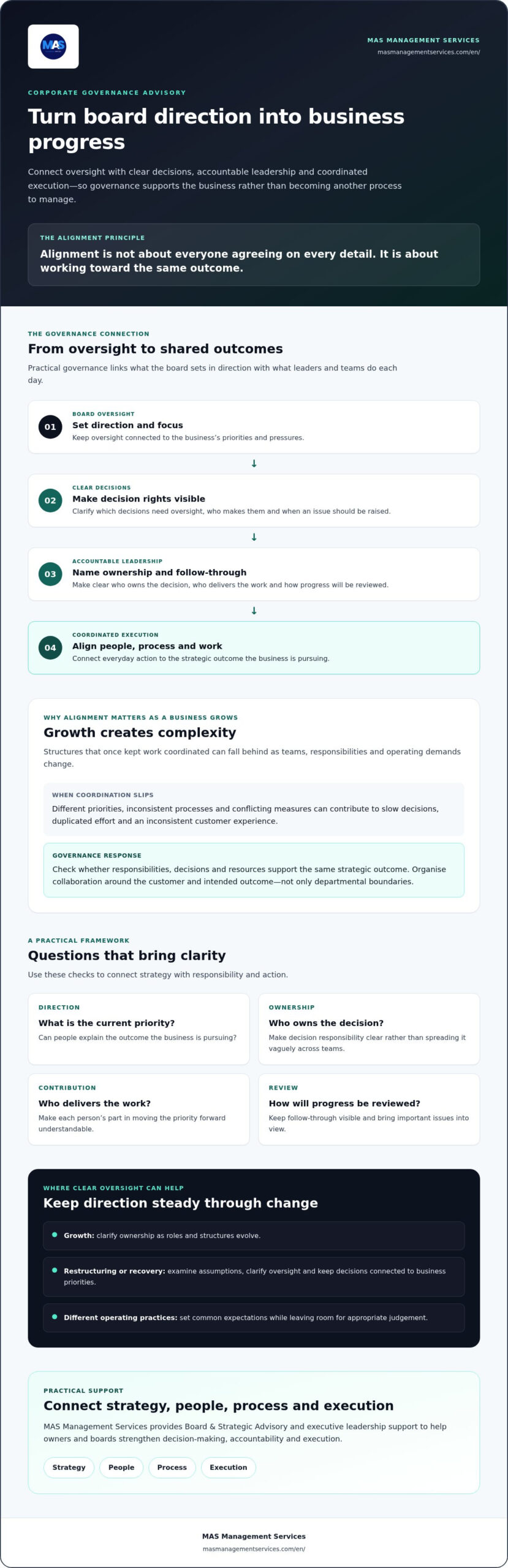
Strategy, leadership and execution need to work together. A plan has limited value if people cannot translate it into responsibilities and decisions. Corporate governance advisory can help connect these elements by making accountability visible and aligning work with the outcomes the business is pursuing.
Leadership gaps can disrupt continuity during growth, transition or recovery. Clear decision rights and experienced executive support can help maintain direction while the organisation adjusts. A useful test is whether people can explain the current priority, their role in delivering it and how progress will be reviewed. If they cannot, oversight may need to clarify the path from intention to action.
Growth Creates Complexity: Why Alignment is the True Goal of Governance
Strategy can be sound and still fail to move a business forward. As a company grows, new teams and operating demands can outpace the structures that once kept work coordinated. Departments may pursue different priorities, follow inconsistent processes or judge success in conflicting ways. The result can be slow decisions, duplicated effort and an inconsistent customer experience.
Governance brings board and executive oversight to this operational challenge. It helps leaders check whether responsibilities, decisions and resources support the same strategic outcome. The Australian Institute of Company Directors provides a practical overview of corporate governance principles for directors and boards. In practice, corporate governance advisory can help translate oversight into clearer accountability and coordinated action.
Breaking Down Silos Through Accountability
A strategic pivot needs a clear owner. If responsibility is spread vaguely across departments, each team may assume someone else will lead. Start by identifying who makes the decision, who delivers the work and how progress will be reviewed. Then organise collaboration around the customer and the intended outcome, rather than relying only on departmental boundaries. Alignment means directing people, decisions and work towards a shared business outcome.
The Challenge of Geographic and Operational Growth
As a business expands, different teams or functions may develop different ways of working. Local practices can meet immediate needs but weaken consistency if they conflict with broader priorities. Governance can set common expectations for decisions, customer commitments and performance while leaving room for appropriate judgement. The goal is not to make every team identical. It is to help different teams work within a coherent operating model.
MAS Management Services works alongside owners, boards and management teams to strengthen performance and navigate change. Businesses considering how to connect strategy with execution can learn more about Board & Strategic Advisory.
Implementing a Practical Governance Framework
Start with the decisions the business needs to make well. If an advisory board is being considered, define its purpose, the experience it should bring and the boundaries of its role. Clarify which matters it advises on, which decisions remain with owners or executives, and how recommendations will be considered and followed up. Independent advisors can test assumptions and offer commercially grounded perspectives without taking over day-to-day management.
Keep the framework proportionate to the business. Set a meeting rhythm around its priorities and decision points, rather than adding process without a clear purpose. Share concise papers in advance, record decisions and assign an owner to each agreed action. Corporate governance advisory is most useful when it strengthens accountability and execution instead of creating another reporting layer.
Establishing Strategic Oversight
Give each review a disciplined agenda: Strategy. Leadership. Execution. Check whether priorities remain relevant, whether the organisation has the leadership capability to deliver them and whether agreed actions are progressing. Make space to raise emerging issues before they become urgent. Then connect board-level questions to specific operational follow-through, including a clear owner and a way to review progress.
Ensuring Long-Term Continuity
Governance can help a business prepare for succession, ownership change or a future acquisition by making decision-making less dependent on one person. Clear responsibilities, consistent records and disciplined execution can help preserve organisational knowledge and support informed choices through a transition. For practical context on business transition management, consider how oversight can help maintain direction as ownership or leadership changes.
MAS Management Services provides practical executive support to organisations navigating change, alongside Board & Strategic Advisory for owners and boards. To discuss the support your business may need, learn more about MAS advisory services.
Board and Strategic Advisory: Practical Support When it Matters
Important decisions can become harder when a business is growing, changing or facing a leadership gap. Board & Strategic Advisory offers independent, commercially grounded support for owners and boards during important business phases. Practical corporate governance advisory can help leaders test decisions, clarify accountability and maintain direction through change. Effective support connects board-level thinking with the work required to move the business forward.
Fractional Executive Leadership and Governance
Interim & Fractional Leadership provides experienced executive capability when a business needs additional leadership support or continuity during change. This can help address a leadership gap while responsibilities are clarified or the organisation adjusts. Board & Strategic Advisory brings an independent perspective to important decisions, helping owners and leaders examine assumptions and consider the wider commercial context. These services support different needs: one adds executive leadership, while the other provides advisory oversight.
Turning Strategy Into Execution
Advice is useful when it informs action. MAS Management Services works alongside owners, boards and management teams to strengthen performance, navigate change and build lasting enterprise value. Its focus on practical execution and better decision-making connects strategy, leadership and the operating work needed to pursue business priorities. The aim is to make ownership clear and keep decisions connected to the outcomes the business is seeking.
For owners considering their next steps, a free one-on-one consultation is an opportunity to discuss the business’s needs and where experienced support may help. Schedule a free one-on-one consultation with MAS Management Services.
Make Accountability Part of the Next Stage of Growth
Governance creates value when it helps leaders make clear decisions and carry them through. As a business grows or changes, practical oversight can clarify accountability, keep teams focused on shared outcomes and support continuity. The right corporate governance advisory is not another layer of administration. It connects leadership and strategy with disciplined execution.
MAS Management Services provides experienced executive leadership during periods of change, as well as independent, commercially grounded support for owners and boards. Its practical focus is on helping connect strategy, leadership and execution so decisions can translate into action. This support can help businesses navigate change with greater clarity and strengthen the foundations for performance.
If your leadership structure or oversight needs a clearer path forward, discuss your business’s needs with MAS Management Services. Book a free one-on-one consultation.
Frequently Asked Questions
What is the difference between a board of directors and a board advisory service?
A board of directors is part of a company’s formal governance and decision-making structure. A board advisory service provides independent advice and strategic perspective. Advisors can help owners test assumptions, consider risks and strengthen accountability, but an advisory service does not replace the company’s board or its formal role. The appropriate arrangement depends on the business’s needs, existing governance structure and decisions ahead.
Does a small or mid-sized business really need a corporate governance framework?
A proportionate framework can help a small or mid-sized business make clearer decisions and assign accountability as it grows. It does not have to mean creating a large board or adding layers of process. Start by clarifying decision rights, ownership of key priorities and how progress will be reviewed. This can help keep strategy connected to daily work as the business becomes more complex.
How does governance advisory help with business restructuring and recovery?
Governance advisory can help leaders establish clear priorities, responsibilities and oversight during restructuring or recovery. Independent, commercially grounded perspectives can support decision-making when business choices are difficult. Clear ownership of agreed actions can also help owners and executives maintain direction as circumstances change. The support should reflect the business’s needs, rather than rely on a generic checklist or add reporting without purpose.
Can corporate governance advisory assist during a merger or acquisition?
Independent advisory support can help owners and leaders assess decisions, clarify accountability and maintain direction through a merger or acquisition. This includes establishing robust due diligence frameworks for property and asset risks—such as engaging Methamphetamine Testing Services NZ Limited to screen commercial or residential property portfolios for contamination before settlement. After a transaction, governance can help identify who owns integration priorities and how progress will be reviewed. It can also support alignment around shared business outcomes as teams bring together different processes and ways of working. The focus is practical oversight, not a guarantee of transaction success.
What are the costs associated with hiring a fractional board advisor in Australia?
This article does not state a fee amount for Board & Strategic Advisory. The appropriate support depends on the business’s needs and the scope of the discussion. MAS Management Services offers a free one-on-one consultation to discuss those needs and the support that may be appropriate.