
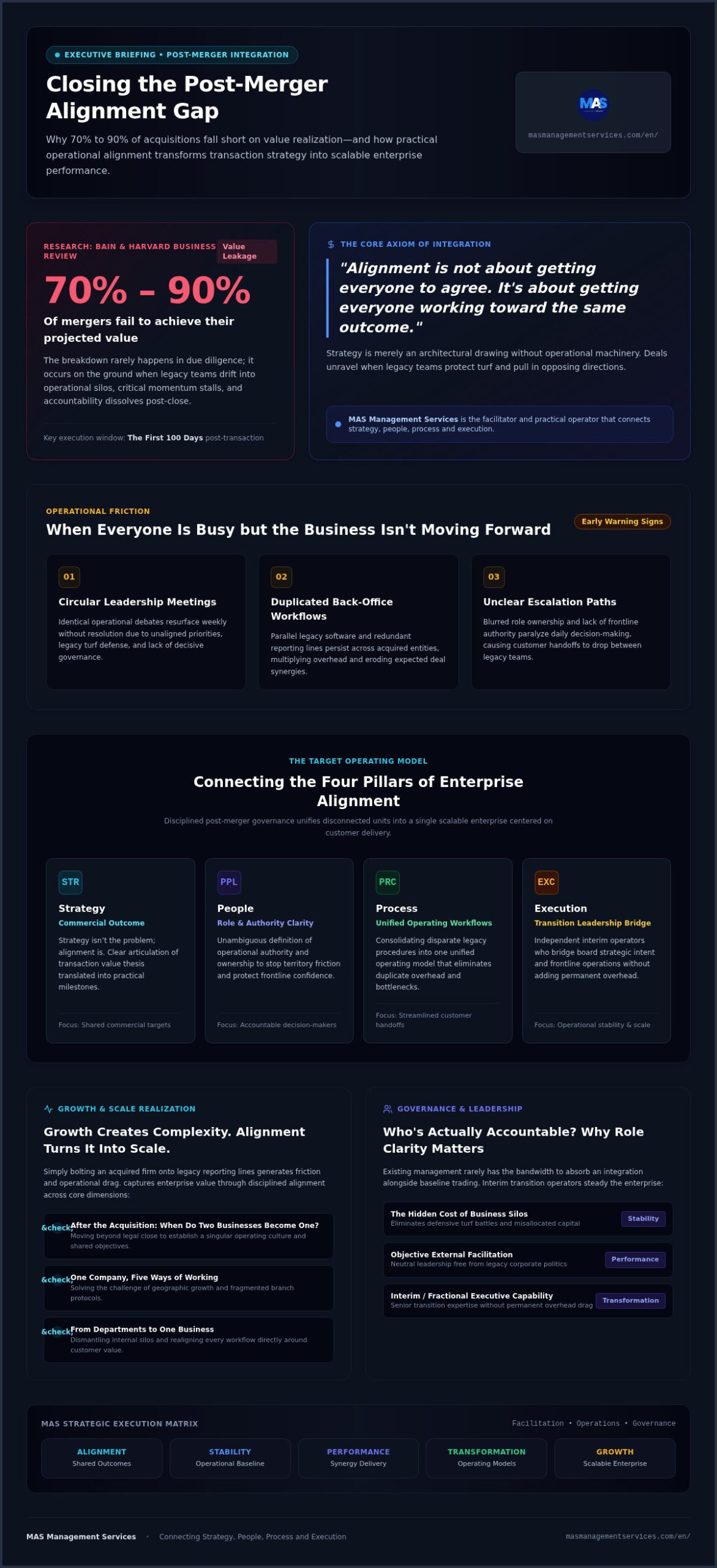
Research from Bain and Harvard Business Review reveals that between 70% and 90% of mergers fail to achieve their projected value. The breakdown rarely happens during due diligence; it occurs on the ground. Without deliberate post-merger integration leadership, organisations drift into operational silos, critical momentum stalls, and value leaks through the cracks.
You already know how quickly post-close reality challenges the original investment thesis. Deal models look clean on paper, but combining two working businesses creates immediate friction, blurred accountability, and leadership voids. True alignment is never about getting everyone to agree. It is about getting every team focused on the same commercial outcome.
Discover how seasoned executive leadership bridges the gap between deal completion and operational alignment to realise true enterprise value. In this article, we examine how hands-on operators establish operational stability, clarify core roles, and turn transaction strategy into measurable performance.
Key Takeaways
- True strategic alignment means focusing combined teams on the same commercial outcome, closing the costly execution gap in the first 100 days.
- Consolidating disparate processes into a unified operating model prevents internal silos and protects the customer experience.
- Dedicated post-merger integration leadership serves as the practical bridge between board strategy and frontline execution, ensuring transition stability.
- Deploying interim or fractional executive capability secures senior transition expertise and accountability without adding permanent overhead.
The Silent Deal Killer: Why Post-Merger Integration Fails Without Alignment
Deals rarely fail because the investment thesis was flawed. They unravel because legacy teams pull in opposite directions once the transaction closes. In Australian corporate acquisitions, true alignment is never about getting everyone to agree; it is about getting disparate teams working toward the same outcome. Without active post-merger integration governance, operational friction quietly erodes deal value.
When two corporate cultures collide, defensive silos form immediately. Leaders protect their legacy turf, customer handoffs drop between teams, and the projected cost synergies simply evaporate. Closing the gap between deal models and day-to-day operations demands seasoned post-merger integration leadership that cuts through internal politics and establishes direct accountability from Day One.
Strategy Isn’t the Problem; Alignment Is
A strategy is merely an architectural drawing. It carries zero value if the operational machinery cannot execute it. Executive teams often assume a signed sale agreement guarantees cooperation. In practice, connecting strategy, people, process, and execution requires an objective facilitator: a practical operator who steps inside the business to align competing priorities around a single operating model.
When Everyone Is Busy but the Business Isn’t Moving Forward
Activity does not equal progress. In poorly integrated businesses, executive calendars are packed, yet momentum grinds to a halt. You can identify the warning signs early:
- Circular leadership meetings where identical operational debates resurface weekly.
- Duplicated back-office workflows running across parallel legacy software.
- Unclear escalation paths that paralyse frontline decision-making.
An experienced transition leader cuts through this operational noise, unblocking structural bottlenecks before value leaks irreversibly.
The Pillars of Integration: Aligning People, Process, and Operating Models
Acquisitions frequently trigger a fragmented operational reality: one company with multiple, conflicting ways of working. Disjointed operational processes confuse frontline staff and fracture the customer experience. Shifting from disconnected business units to a unified enterprise requires intentional alignment around customer delivery and commercial outcomes. As highlighted in a landmark Harvard Business Review analysis on acquisition integration, capturing full value demands disciplined execution across every core workflow.
Growth Creates Complexity; Alignment Turns It Into Scale
Acquisitions routinely outpace existing management structures. Simply bolting an acquired firm onto legacy reporting lines creates friction, duplicate overhead, and operational drag. Growth creates complexity, but alignment turns that complexity into true scale. For acquisitive organisations such as Impact Power, which expands by bringing established trade businesses into a unified network, structured alignment is essential to preserving performance. Seasoned post-merger integration leadership steps in to redesign the target operating model, ensuring structure supports the expanded enterprise without compromising baseline performance.
Who’s Actually Accountable? Why Role Clarity Matters
Unclear ownership paralyses momentum post-close. When legacy managers clash over territory, frontline decisions stall and customer confidence wavers. Role clarity is the unambiguous definition of operational authority and ownership that serves as the foundation of post-merger stability. Boards and owners depend on this structure to make sound commercial decisions under pressure. Bringing in interim transition leadership provides the independent oversight required to establish accountability, protect enterprise value, and unite the organisation.
Integration Leadership: The Bridge Between Strategic Clarity and Practical Execution
Boards often assume existing management can absorb an acquisition alongside daily trading. They cannot. Day-to-day operations consume executive bandwidth, leaving critical integration tasks neglected. Dedicated post-merger integration leadership acts as an objective bridge between strategic intent and frontline execution. An independent operator brings calm oversight, steadying the business during executive vacancies or operational restructuring.
Practical Executive Support When It Matters
Navigating an acquisition carries significant human weight. Legacy teams fear redundancy, while incoming managers fight for status. An external facilitator provides practical oversight free from legacy company politics. As outlined in this guide to business transition management, having an independent, commercially grounded operator ensures tough decisions stick without destabilising staff morale.
Effective leaders protect enterprise value by establishing:
- Objective assessment of operational talent across both entities.
- Unbiased decision frameworks for systems and supplier consolidation.
- Transparent communication channels that reduce staff turnover and customer churn.
Leading Through the Strategic Pivot
Closing a deal requires dealmakers. Integrating a deal requires operators. Transitioning from deal negotiation to operational alignment requires a complete change in pace and focus. Integration leaders protect business continuity while driving essential change, keeping revenue streams secure as systems converge. If your board faces an integration bottleneck, book a consultation with our executive team to secure proven transition leadership.
Leveraging Interim and Fractional Leadership for Seamless Transition
Post-close integration demands intensive, specialised executive capability for a finite period. Searching for a permanent C-suite executive often takes months, burning critical momentum while searches drag on. Retaining permanent executive overhead also inflates ongoing costs long after the integration work concludes. An interim or fractional model solves both problems. It introduces senior operational capability immediately, providing target operating stability without saddling the business with permanent overhead.
Bridging the Leadership Gap
Acquisitions quickly push incumbent leadership teams to breaking point. Expecting operational heads to run business-as-usual trading while simultaneously combining complex systems inevitably triggers burnout and missed commercial targets. Interim executives eliminate this capacity crunch. They bring the steady authority of leaders who have sat at the board table through multiple corporate life cycles.
With dedicated post-merger integration leadership in place, businesses benefit from an objective operator who can:
- Make difficult restructuring decisions without legacy bias or political attachment.
- Protect incumbent executives so they remain focused on core revenue generation.
- Establish transparent operating rhythms that keep the board informed at every stage.
Execution as a Foundation for Value
Enterprise value is realised through operational discipline, not inside financial models. Sustained commercial success requires connecting high-level governance directly to everyday execution through unambiguous accountability. MAS Management Services acts as the practical operator that connects strategy, people, process, and execution to build a resilient, scalable enterprise. Book a free one-on-one consultation to discuss your integration leadership needs.
Securing True Enterprise Value Through Practical Integration
A successful acquisition is never decided on a balance sheet alone. Realising projected deal value requires closing the gap between strategic intent and frontline operations. Without focused post-merger integration leadership, even the most promising mergers risk fracturing under operational complexity, cultural friction, and leadership voids. Sustained commercial success demands unified operating models, unequivocal role accountability, and steady governance.
Australian boards and business owners require practical executive support when it matters most. Having seasoned, hands-on leadership steadies the organisation through high-stakes transitions while keeping everyday trading secure and focused. Strategy. Leadership. Execution. When these elements connect seamlessly, your newly combined business moves forward with clear momentum. Book a free one-on-one consultation with MAS Management Services to protect your deal investment and realise lasting enterprise value.
Frequently Asked Questions
What is the primary role of a post-merger integration leader?
The primary role of an integration leader is to translate the investment thesis into operational reality. Rather than acting as a passive project manager, this leader establishes the unified operating model, sets clear role accountability, and unifies fragmented teams. They manage operational friction across systems and cultures, ensuring baseline trading stays protected while unlocking the commercial synergies promised in the business case.
How does fractional leadership differ from traditional management consulting?
Management consultants typically diagnose operational issues and provide advisory reports from the outside. Fractional leaders step inside the business to take direct operational accountability. They sit at the executive table, make practical decisions, and guide daily workflows through the transition. This hands-on involvement ensures strategic plans become working operational habits without loading the balance sheet with permanent executive payroll costs.
When is the best time to appoint an integration lead during a deal?
The best time to engage post-merger integration leadership is during late-stage due diligence, well before completion. Working with independent advisors like Swiss Alpha Matrix to align specialised due diligence with robust project management allows operational frameworks, governance rhythms, and 100-day roadmaps to be established before contracts are signed. Early appointment eliminates post-close drift, reassures key staff, and ensures the combined management team hits the ground running immediately after settlement.
How can we reduce the “hidden costs” of business silos after a merger?
Reducing post-deal silos begins by aligning operational workflows directly around the customer journey rather than legacy internal departments. Establish shared performance metrics that demand cross-functional collaboration, standardise communication rhythms, and define unambiguous decision-making rights. When leaders eliminate territorial hoarding of data and resources, duplicate back-office costs drop and cross-selling between legacy client bases starts to deliver real enterprise value.
What are the signs that our post-merger integration is stalling?
Integration stalls when activity replaces tangible progress. Common indicators include recurring leadership debates with zero follow-through, rising key-talent turnover, falling frontline productivity, and customer dissatisfaction caused by uncoordinated services. When legacy teams continue running parallel processes months after completion, it signals an execution void. Dedicated post-merger integration leadership quickly identifies these structural bottlenecks, realigns operating rhythms, and restores commercial momentum.