
What if your strategy is sound, but the organisation lacks the leadership capacity to carry it through? An executive leadership consultation can help clarify whether you need focused advice, hands-on executive leadership or another form of support. That distinction matters when decisions are consequential and strategic priorities aren’t becoming accountable action.
You may already know the business needs to move forward. The harder question is what’s getting in the way: unclear priorities, gaps in accountability, limited leadership capacity or a need to align people and processes around the same outcome. Alignment doesn’t require everyone to agree. It requires people to understand the shared direction and their role in working towards it.
This article explains what to clarify before an executive leadership consultation, how to identify the leadership capability your situation calls for, and what practical next steps may help. It also considers how support such as Interim & Fractional Leadership, Growth & Transformation or Board & Strategic Advisory can connect strategy with execution. The aim is a clearer view of the issue and the support that may fit, without assuming the answer in advance.
Key Takeaways
- Describe the business issue, its impact and why it needs attention now to make an executive leadership consultation focused and useful.
- Clarify who owns the decision and which leaders or teams need to work towards the same outcome.
- Prepare a plain-language summary of the desired direction and the decisions that remain unresolved.
- Consider whether the situation calls for strategic advice or practical leadership support, then explore which form may fit.
Executive leadership consultation: when is an outside perspective useful?
A leadership gap can put continuity under pressure. Major change can unsettle established roles, while growth can stretch a structure that once worked well. In these situations, an executive leadership consultation offers a focused conversation about the business need and the support that may fit. The broader practice of Management consulting centres on helping organisations improve performance, but a useful discussion starts with the details of your situation.
Alignment doesn’t mean everyone must agree. It means leaders and teams understand the shared outcome and work towards it. Strategy only creates value when people are accountable for putting it into action.
Which business situations may prompt a consultation?
Consider an outside perspective when the business issue raises questions about capability, continuity or oversight. For example:
- Leadership gap: Who can maintain direction and decision-making while a key role is unfilled or changing?
- Major transition: Is there enough leadership capacity to guide the business through a restructuring or significant change?
- Performance pressure: Are priorities and accountability clear enough to address the issue?
- Growth-related strain: Can the current structure, roles and processes support the organisation’s next stage?
These situations don’t automatically call for an external executive. First, identify what is missing. Is it decision-making capacity, clear ownership, strategic oversight or the ability to carry agreed priorities through? For organisations exploring executive advisory to help owners and leadership teams build more effective, profitable structures, learn more about StrategyForge Partners.
Advice, alignment or executive leadership?
If the main difficulty is uncertainty about priorities, decisions or ownership, the immediate need may be clearer thinking and alignment. If the direction is understood but the organisation lacks the capacity to lead and coordinate the work, practical executive support may be worth considering. In some cases, the business can address the issue internally once responsibilities are clear.
The distinction matters. Interim & Fractional Leadership, Growth & Transformation or Board & Strategic Advisory may be relevant to different needs. Start by describing the problem, then consider which kind of support could address it.
What should an executive leadership consultation help you clarify?
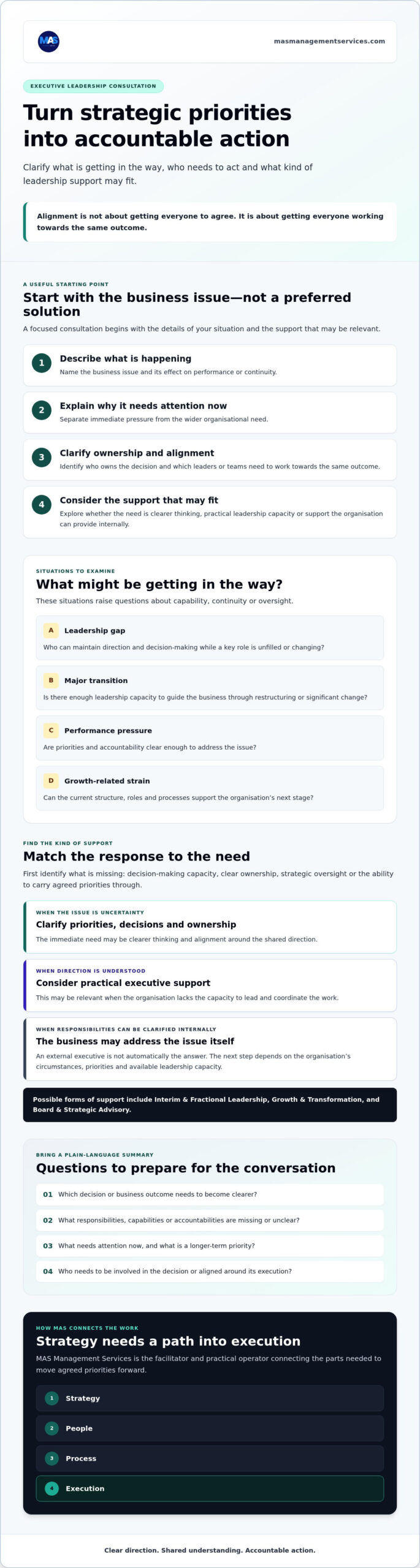
A useful conversation starts with the business issue, not a preferred solution. Describe what’s happening, how it affects performance or continuity, and why it needs attention now. Then identify who owns the decision and which leaders or teams need to work towards the same outcome. Alignment doesn’t require consensus on every point. It requires a shared understanding of the priority and clear accountability for action.
The focus may be continuity during a leadership gap, change across the organisation, performance under pressure or strategic oversight. Understanding executive leadership can help frame the discussion around the decisions, direction and responsibilities that sit with senior leaders.
Questions to bring to the first conversation
Bring a plain account of the situation. These questions can help separate immediate pressure from the wider organisational need:
- Which decision or business outcome needs to become clearer?
- What responsibilities, capabilities or accountabilities are missing or unclear?
- What needs attention now, and what is a longer-term priority?
- Who needs to be involved in the decision or aligned around its execution?
If leadership continuity during a transition is the central concern, the interim executive services guide offers a related perspective.
What a useful conversation should establish
The first discussion should help describe the issue and consider what kind of support may be relevant. It shouldn’t assume that an external executive is necessary or promise a particular outcome. The right next step depends on the organisation’s circumstances, priorities and available leadership capacity.
MAS offers a free one-on-one consultation to discuss how its services may benefit a business. If you’re weighing up the issue, you can discuss your business needs in a free consultation.
How to prepare for an executive leadership consultation
A little preparation can make an executive leadership consultation more focused. You don’t need a polished brief or a complete answer. Bring a clear account of what’s happening, what direction you want the business to take and which decisions remain unresolved. This gives the conversation a practical starting point without locking you into a solution.
Preparation checklist
- Describe the situation plainly. Note what has changed, what isn’t working and why the issue needs attention now.
- Set out the desired direction. Identify the business outcome you’re working towards, even if the route is still uncertain.
- Map people and accountabilities. List affected stakeholders, who currently owns key decisions, and where responsibility or capability is unclear.
- Record constraints and open decisions. Note relevant operating limits, immediate pressures and decisions that could affect next steps.
Information worth organising beforehand
Have relevant strategic priorities, the current organisational structure and known performance concerns to hand. Add a brief record of significant changes and critical decisions. Together, these details can help distinguish urgent operational pressures from longer-term priorities, without letting one obscure the other.
If a change in ownership or business structure is central, read the business transition management guidance for a related perspective.
How to assess whether support fits
Compare the business need with the relevant service. Interim & Fractional Leadership may be worth discussing when executive capability or continuity is a concern. Growth & Transformation, Restructuring & Recovery or Board & Strategic Advisory may be relevant to other priorities. Treat these as starting points, not a diagnosis. Fit depends on your organisation’s circumstances and what it needs to address.
Bring your questions to a free one-on-one consultation with MAS Management Services to discuss which support may be relevant.
How MAS connects leadership consultation with practical execution
An executive leadership consultation can help frame the business issue before any form of support is discussed. The question is not simply whether the organisation needs an adviser or an executive. It is what needs to change, who needs to lead it, and what capability or oversight may be appropriate.
MAS Management Services works alongside owners, boards and management teams to strengthen performance, navigate change and build lasting enterprise value. Its services focus on experienced executive leadership, practical execution and better decision-making. A consultation is an opportunity to discuss the organisation’s circumstances and consider relevant support, without presuming a particular service or result.
Matching the discussion to the leadership need
The support to explore depends on the issue. Interim & Fractional Leadership may be relevant when additional executive capability, continuity or steady oversight is needed. Growth & Transformation may suit a business working through growth or change. Restructuring & Recovery may be relevant where performance pressure or organisational restructuring is central. For strategic direction and oversight, Board & Strategic Advisory may warrant discussion.
These service descriptions can help you frame the conversation, but they aren’t a substitute for considering your specific priorities and constraints.
From shared direction to accountable action
Alignment is practical. It clarifies the outcome, the responsibilities attached to it and the next steps leaders need to consider. People don’t need to agree on every detail, but they do need a shared direction and a clear view of how their work contributes to it. Connecting priorities with structure, accountability and operating processes helps keep strategy grounded in how the organisation works.
If you’re weighing up a leadership challenge or a change in direction, book a free one-on-one consultation with MAS to discuss your business needs and whether its support may be suitable.
Turn strategic priorities into accountable action
A useful executive leadership consultation starts with a clear view of the business issue, the decisions it affects and the capability needed to address it. Preparing that picture helps distinguish a need for advice from a need for practical executive support. It also gives leaders a stronger basis for aligning around shared outcomes and assigning accountability.
MAS Management Services works alongside businesses to connect strategy with practical execution. Depending on the circumstances, support may include Interim & Fractional Leadership or Board & Strategic Advisory. The right fit depends on the organisation’s needs and priorities. MAS’s purpose is to help build better businesses.
A free one-on-one consultation is available to discuss how its services may benefit your business. Book a free one-on-one consultation to discuss your priorities and practical next steps.
Frequently Asked Questions
What happens in an executive leadership consultation?
An executive leadership consultation gives a business owner, board or management team a chance to discuss its situation and consider whether executive support may be relevant. You can outline the business issue, the decisions needing attention and the outcome you’re working towards. The discussion can help clarify what matters. Ask MAS about the format and any preparation that would be useful before you meet.
Is an executive leadership consultation free?
Yes. MAS Management Services offers a free one-on-one consultation to discuss how its services may benefit a business. Use the conversation to explain your circumstances and clarify what support may be relevant. If you have questions about the meeting or what to prepare, raise them with MAS when arranging the consultation.
Who should attend an executive leadership consultation?
The most relevant participants depend on the issue and who is responsible for addressing it. A business owner, board member or management leader can begin by explaining who owns the decision and whose input is needed. Not every stakeholder needs to attend the first conversation. Start with the people best placed to describe the situation, then consider who else should contribute.
How do I know whether my business needs interim or fractional leadership?
Consider whether the organisation needs additional executive capability, continuity or steady oversight during a transition. In specialised technical sectors, bringing in a Fractional CTO for wealth management or a targeted functional leader can bridge capability gaps without requiring a permanent hire. If the main issue is uncertainty about a decision rather than a gap in leadership capacity, explain that distinction. MAS can discuss whether Interim & Fractional Leadership or another service may be relevant to your circumstances. The right fit depends on the business need.
What should I prepare before speaking with an executive adviser?
Prepare a concise account of the business issue, its effect and the decision that needs attention. Note the outcome you want to work towards, any relevant changes, current accountabilities and people involved. You don’t need to arrive with a complete solution. A clear description of what’s known, what remains unresolved and why it matters can help focus the discussion.