
A leadership vacancy is never just an empty desk. It’s a drain on momentum. It costs your business more than just a salary. You feel the weight of a sudden gap in the C-suite. Uncertainty among the board. Anxiety in the ranks. A stall in strategic execution. Losing operational speed during a recovery or restructuring isn’t an option. Our guide to interim executive services explains how to bridge these high-pressure gaps with precision.
Discover how specialised leadership provides the immediate stability and accountability required to navigate complex transitions. We’ll examine how to turn uncertainty into a clear path for a permanent solution. A successful business turnaround. Strategy isn’t the problem. Alignment is. This guide shows you how to connect strategy, people, and process when the stakes are highest. It’s about getting everyone working toward the same outcome. Stability in uncertain times.
Key Takeaways
- The “doer” distinction. Interim leaders take full operational responsibility rather than just providing advice.
- Critical scenarios for interim executive services. Bridge leadership gaps during sudden vacancies or periods of financial restructuring.
- Choosing the right model. Contrast full-time interim support with the ongoing senior oversight of fractional leadership.
- Alignment as a strategic outcome. Establish clear accountability and governance during high-pressure transitions.
What are Interim Executive Services? Stabilising Your Organisation in Transition
Interim executive services involve the rapid deployment of seasoned senior leaders to manage periods of intense change, vacancy, or growth. This is not a “seat-filler” solution. It is a tactical intervention. We provide the specialised transition expertise required to protect value and maintain momentum when a permanent leader departs or a crisis emerges. The focus is always on immediate operational stability.
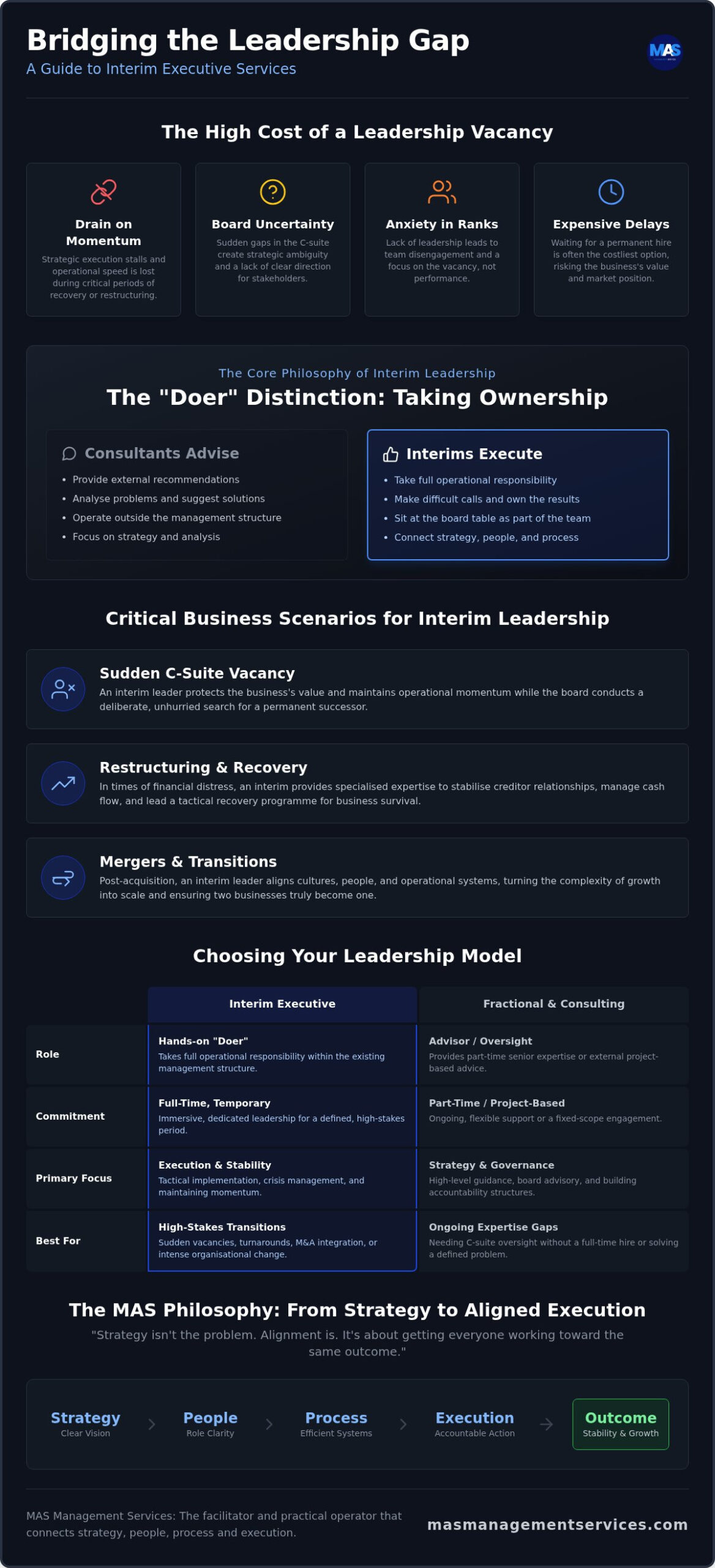
The primary difference between an interim leader and a consultant is the “doer” distinction. Consultants advise. Interims execute. They take full operational responsibility for their function. They sit at the board table, make difficult calls, and own the results. Strategy isn’t the problem. Alignment is. This hands-on approach ensures that strategy, people, and process are connected to a single outcome.
The Core Philosophy of Interim Leadership
Stability is the first priority. During organisational volatility, an interim leader provides a steady hand. They offer accountability from day one. Most interims are over-qualified for the specific assignment. They bring a depth of experience that allows them to see risks before they manifest. They don’t need a learning curve. They arrive ready to lead.
Key Executive Roles Served
- Interim CEO: Restores board-level confidence and provides strategic oversight during sudden vacancies.
- Interim CFO: Directs financial restructuring, manages cash flow, and oversees recovery programmes in distressed environments.
- Interim COO: Stabilises operations and improves supply chain efficiency to turn growth complexity into scale.
These leaders bring an objective, independent perspective. They are not hindered by internal company politics. Their sole focus is performance and transformation. They bridge the gap between a departure and a permanent appointment without losing momentum.
When to Hire an Interim Executive: Critical Business Scenarios
Leadership gaps are rarely planned. They occur at the intersection of crisis and opportunity. Identifying the right time to engage interim executive services is a matter of recognising when internal capacity no longer matches external pressure. When the stakes are high, waiting for a permanent hire is often the most expensive option.
Sudden vacancy remains a common trigger. When a CEO or key executive departs unexpectedly, strategic direction often falters. The interim leader steps in to protect the business’s value while the board conducts a deliberate, unhurried search for a permanent successor. This prevents a loss of operational momentum. It keeps the team focused on performance rather than the vacancy.
Restructuring and Recovery Leadership
Financial distress requires a specific temperament. It involves stabilising creditor relationships and managing high-pressure financial environments where cash flow is the priority. We identify operational inefficiencies that lead to financial leakage and performance pressure. Restructuring is a tactical recovery tool for business survival. It provides the breathing room needed to implement long-term fixes. This process builds accountability and restores confidence for stakeholders and investors alike.
Guiding Business Transitions and Mergers
Transition is more than a change in ownership. It’s a period of high risk. Post-merger integration involves aligning cultures, people, and operational systems after an acquisition. Without this alignment, two businesses never truly become one. Growth creates complexity. An interim leader turns that complexity into scale by bridging the gap between outgoing founders and incoming management. They ensure the legacy is preserved while the operational model is modernised.
Managing the human element of leadership change requires pragmatic empathy. People need clear communication during uncertainty. If your organisation is facing these pressures, a free 1-on-1 consultation can clarify the immediate steps required for stability. Growth outpaces structure quickly. Senior oversight ensures that performance doesn’t suffer during a strategic pivot.
Interim vs. Fractional vs. Consulting: Choosing Your Model
Selecting the right leadership structure is a strategic decision. It depends on the urgency of the gap. The level of involvement required. Interim executive services provide a full-time, immersive solution for high-stakes transitions. Built for speed. Tactical execution. Stability in uncertain times. Fractional and consulting models serve different operational needs. The choice defines the pace of your business recovery.
When Fractional Leadership Makes Sense
Fractional leadership offers part-time senior expertise on an ongoing basis. C-suite oversight without the full-time salary. No overhead burden. Consistent governance. Board-level advisory. It builds accountability structures for future growth. Why role clarity matters becomes evident here. This model ensures the business keeps moving forward even when everyone is busy. If you are unsure which model fits, book a free 1-on-1 consultation to discuss your requirements.
Why Interims Outperform Traditional Consultants
Consultants focus on strategy. Strategy over execution. They provide a report and depart. Interims are different. They hold real power within the organisational chart. They stay to implement the strategy. They own the results. The benefits are clear:
- Execution focus. Implementing change, not just recommending it.
- Internal authority. Driving transformation from within the C-suite.
- Speed to results. Minimal ramp-up time. Deep sector experience.
The economic argument is based on the cost of delay. Permanent searches take six months. Another six for full productivity. An interim leader delivers immediate impact. They protect revenue. They prevent operational leakage. ROI is found in stability. Comparing the cost of a leadership vacancy against the fee of an interim often reveals a significant saving. Strategy isn’t the problem. Alignment is. Getting everyone working toward the same outcome. Practical operators who connect strategy, people, and execution.
Strategic Board Advisory and Ensuring Long-Term Alignment
Effective interim executive services provide more than operational cover. They offer an objective, independent perspective to the board. Free from internal history. Unbiased by legacy politics. This distance allows for a level of candour that permanent staff often cannot provide. It’s essential during high-stakes transactions or periods of rapid transformation. The focus remains on enterprise value.
Board-Level Accountability and Oversight
The interim leader acts as a bridge. They connect operational management with board-level expectations during the growth phase. They ensure governance standards remain high even when the pace of change is rapid. The board advisor serves as a guardian of shareholder and enterprise value. This oversight builds confidence with external stakeholders and investors. Accountability is built into every process. Role clarity matters at the board level to drive performance.
Strategy isn’t the problem. Alignment is. Real alignment is not about getting everyone to agree. It’s about getting every department working toward the same outcome. We facilitate this connection between strategy, people, and execution. We are practical operators who turn growth complexity into scale through functional unity.
The Handover: Ensuring Sustainable Success
The measure of success is what remains after the interim term ends. A robust handover strategy is non-negotiable. We document new processes and strategic changes to ensure they become part of the organisational DNA. They must outlast the temporary engagement. This ensures the business doesn’t move backward when the interim departs. Mentoring the permanent successor ensures a smooth transition. It protects the cultural fit and maintains the momentum built during the recovery.
Leadership transitions are consequential. They require a steady hand and a clear path forward. Book a free 1-on-1 consultation to discuss your specific leadership transition. Practical operators. Stability in uncertain times. Performance through alignment.
Securing Your Organisation’s Future
Leadership transitions don’t have to result in a loss of momentum. By engaging interim executive services, you ensure that stability and performance remain at the centre of your operations. This isn’t about filling a seat. It’s about tactical intervention. Our approach provides hands-on leadership that connects strategy, people, and process. We focus on restructuring and recovery with a commercially grounded perspective. You gain an independent voice. A guardian of enterprise value.
Alignment is the critical factor. It’s not about agreement. It’s about getting everyone working toward the same outcome. When your business faces financial distress or growth complexity, senior oversight provides the accountability required for a successful turnaround. We bridge the gap between a vacancy and a permanent solution without sacrificing results.
If your business is facing a leadership gap, take the first step toward stability. Book a free 1-on-1 consultation with a senior executive advisor to discuss your path forward. Let’s ensure your next transition leads to sustainable growth. You don’t have to manage the weight of change alone.
Frequently Asked Questions
What is the typical duration of an interim executive assignment?
Assignments typically range from six to eighteen months. The exact duration depends on the complexity of the transition or the time required to find a permanent successor. Some engagements are shorter for specific projects like restructuring. Others extend if the board requires ongoing stability during a major transformation. We ensure the term is long enough to deliver results but remains focused on a defined exit strategy.
How much do interim executive services cost compared to permanent hires?
The cost of interim executive services is often lower than the total expense of a permanent hire when considering recruitment fees, benefits, and long-term bonuses. You pay for immediate expertise without the overhead of a permanent salary package. This model provides a high return on investment by protecting enterprise value during a vacancy. It prevents the financial leakage associated with poor decision-making or lost operational momentum.
Can an interim executive help with a business turnaround or restructuring?
Yes. Interim leaders are frequently engaged specifically for restructuring and recovery. They provide hands-on leadership for businesses in financial distress. This involves stabilising cash flow, managing creditor relationships, and identifying operational inefficiencies. Because they are independent, they can make the difficult calls required for a successful turnaround. They focus on practical execution to restore performance and build lasting value for the board and shareholders.
What is the difference between a fractional executive and an interim executive?
An interim executive usually works full-time for a fixed period to manage a specific crisis or vacancy. They are immersive and tactical. A fractional executive works part-time on an ongoing basis. This model provides senior oversight and governance for businesses that don’t yet require a full-time C-suite role. Both provide senior expertise. The choice depends on the intensity and urgency of your current leadership requirements.
How quickly can an interim executive be deployed into my organisation?
Deployment can happen very quickly, often within days or a week. This speed is a core advantage of the model. Unlike permanent recruitment, which can take months, interim executives arrive ready to take responsibility immediately. They have sitting experience and don’t require a long learning curve. This rapid response is critical when a CEO leaves suddenly or a business faces an unexpected financial challenge or strategic pivot.
Does an interim executive take legal responsibility for the company?
Interim executives typically operate within the same legal framework as any other senior leader in your organisation. They are often appointed as officers of the company. This means they carry the same fiduciary duties and accountabilities as permanent executives. They take full operational responsibility for their decisions. This ensures they are personally invested in the governance and performance outcomes of the business during their term of engagement.
Will an interim leader fit into our existing company culture and team?
Experienced interim leaders are experts at cultural integration. They have worked across diverse industries and environments. They understand how to build trust with existing teams quickly. Their goal is not to disrupt the culture but to align it with strategic objectives. They provide pragmatic empathy during uncertain times. This professional distance actually helps them manage team anxieties and maintain focus on performance during a difficult leadership transition.
How do we measure the success of an interim executive engagement?
Success is measured against specific, pre-defined outcomes and key performance indicators. These might include the successful completion of a restructuring programme, the stabilisation of cash flow, or a seamless handover to a permanent hire. We look at operational performance and the restoration of board confidence. The ultimate metric is whether the business is in a stronger, more aligned position than when the engagement first commenced.