
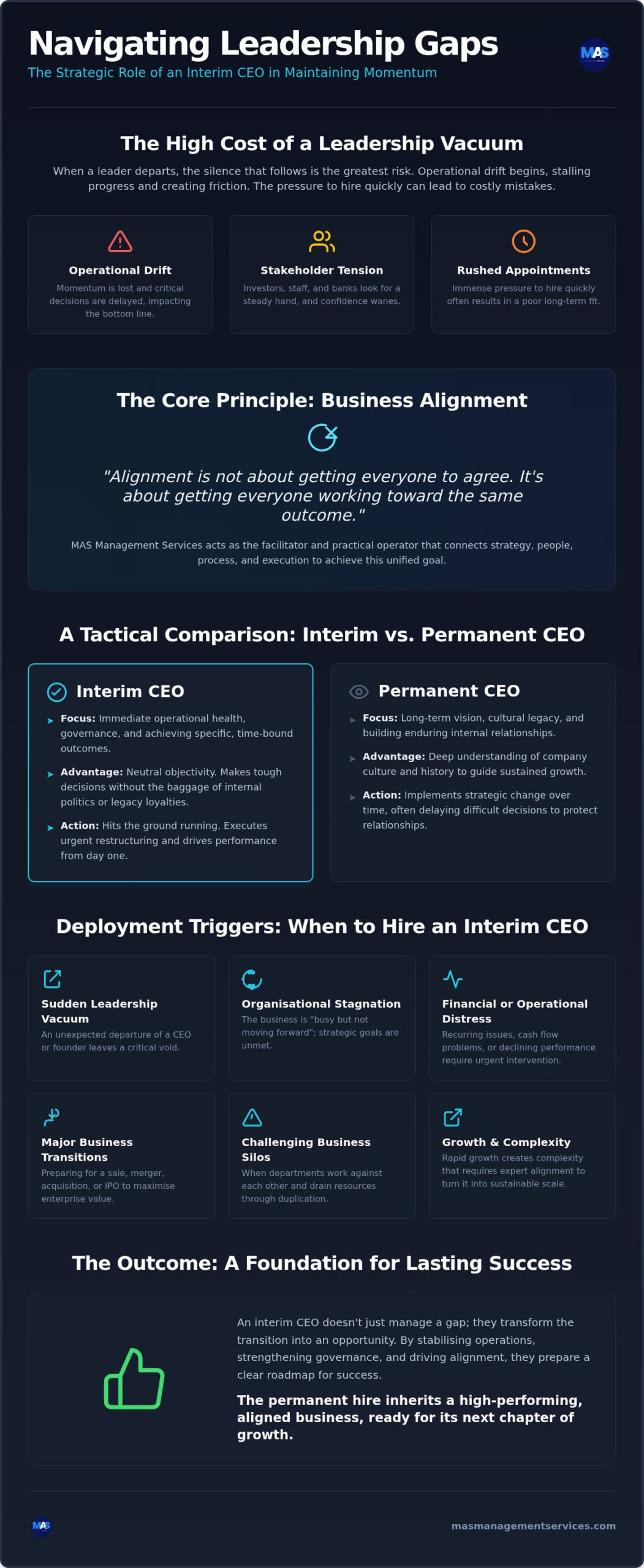
The most significant risk to a company is not the departure of a leader; it’s the silence that follows. When a CEO leaves, operational drift begins. Stakeholders feel the tension. Investors, staff, and banks look for a steady hand. The pressure to hire quickly is immense, yet a rushed appointment is often a costly mistake. Engaging interim CEO services offers a different path. It provides immediate stability while protecting the long-term health of the organisation.
You understand that a leadership gap can stall progress and create internal friction. This article explains how a seasoned interim executive brings the alignment and accountability necessary to maintain momentum. Alignment is not about getting everyone to agree; it’s about getting everyone working toward the same outcome. We will examine how this strategic bridge secures your operations, reassures your stakeholders, and prepares a clear roadmap for your permanent successor. The transition becomes an opportunity for governance and performance, not just a period of waiting.
Key Takeaways
- Understand the strategic role of time-bound leadership in maintaining momentum during a vacancy or pivot.
- Stabilise operations and restore stakeholder confidence through professional interim CEO services.
- Identify the signals for intervention, particularly when organisational stagnation means the business is busy but failing to move forward.
- Build a clear roadmap for succession to ensure the permanent hire inherits a high-performing, aligned business.
The Strategic Function of Interim CEO Services
Interim CEO services offer more than a temporary presence at the head of the table. They provide high-level leadership during critical vacancies, restructuring, or strategic pivots. Unlike a permanent hire, an interim CEO is a time-bound resource. They focus on specific organisational outcomes. This leader acts as a neutral party. They make objective decisions without the baggage of internal politics. Effectively, an interim CEO is a pragmatic operator who facilitates stability and alignment across the entire business.
Interim vs. Permanent Leadership: A Tactical Comparison
Permanent leaders focus on long-term vision and cultural legacy. Interims focus on immediate operational health and governance. They arrive with a proven playbook from previous Interim Management transitions. This experience allows them to hit the ground running from day one. The temporary nature of the role creates a unique advantage. It encourages a focus on urgent restructuring that permanent hires might delay to protect their long-term internal relationships. They act with a level of independence that is difficult for a permanent successor to replicate.
The Value of Embedded Executive Leadership
An embedded leader provides direct accountability to the board when the organisation is at a crossroads. They don’t just advise; they execute. This presence maintains stakeholder confidence through clear, experienced communication and steady oversight. Banks, investors, and staff need to see a seasoned hand on the wheel. By using interim CEO services, the board ensures that the transition period is used to drive performance rather than simply managing a leadership gap. It’s about connecting strategy to execution through practical alignment.
Operational Excellence: How Interim CEOs Stabilise Organisations
Operational stability is the immediate priority. Interim CEO services deliver the necessary oversight to protect the bottom line and reassure creditors. This starts with cash flow. In distressed or high-growth environments, capital can vanish without disciplined management. A seasoned operator steps in. They conduct rapid, independent assessments. No internal bias. No legacy loyalties. They evaluate the management team and the organisational structure. They identify what works and what fails to deliver value. This objective view is critical for the board.
Governance is more than a compliance exercise. It is a framework for transparency and risk management. The board requires clear, unvarnished data to make informed decisions. Accountability follows. This process connects strategy to execution. Every department must work toward the same outcome. Alignment is not about getting everyone to agree. It’s about getting everyone working toward the same outcome. When sales targets conflict with production capacity, the business stalls. Alignment ensures everyone pulls in the same direction.
Restructuring and Recovery Under Transitional Leadership
Recovery requires identifying hidden costs. Business silos drain resources. They create duplication and internal friction. Utilising interim CEO services during a turnaround provides the distance needed to cut costs without damaging the core business. An interim leader executes difficult decisions with commercial discipline. Cost reduction. Resource allocation. These are handled with precision. The goal is to restore performance while preparing the organisation for its permanent successor.
Managing Business Transitions and Ownership Changes
Transitions are inherently volatile. Mergers, acquisitions, and strategic pivots create uncertainty for staff and investors. A steady hand prevents talent attrition. People remain committed when they see clear direction and professional oversight. If your organisation is facing a complex shift, a free 1-on-1 consultation can help define the path forward. Professional leadership during ownership changes protects enterprise value. It ensures the business maintains momentum while the new structure takes shape.
Deployment Triggers: When to Hire an Interim CEO
Triggers for leadership intervention often appear suddenly. A long-tenured CEO or founder departs, leaving an immediate vacuum. In other cases, the signs are more subtle. The business feels “busy but not moving forward.” Teams are active, yet performance plateaus and strategic goals remain unmet. Financial pressures or recurring operational issues also demand a specialist who can act with commercial discipline. Preparing for a sale, merger, or IPO requires a neutral leader. This individual ensures the organisation is optimised for maximum enterprise value before the transaction occurs. They focus on the numbers and the governance without the distraction of internal history.
The 5-Step Evaluation for Leadership Gaps
Determining the need for external leadership requires a cold assessment of the current state. The first three steps are critical for the board. Step 1: Assess the immediate risk to operations and stakeholder trust. Will key staff or investors lose confidence? Step 2: Define the critical objectives for the next 6 to 12 months. This is about what must be achieved, not just what must be maintained. Step 3: Determine if the internal team has the capability to lead the transition. Often, internal candidates are already at capacity. They cannot fix the business while running it. Professional oversight ensures these questions are answered with data rather than optimism.
Mitigating Risk During the Executive Search
Rushing a permanent CEO hire is a mistake boards often regret. These rushed appointments frequently lead to expensive, long-term failures. The search for the right leader takes time. Interim CEO services provide the necessary breathing room. The interim leader doesn’t just fill a seat. They refine the role requirements for the eventual permanent successor. They identify the specific skills and temperament needed to lead the next chapter of the company. If your board is facing a leadership gap, book a free 1-on-1 consultation to discuss a tailored transition strategy. This approach ensures you hire for the future, not just to solve a current crisis.
Ensuring Long-Term Success: The Handover and Succession
A successful tenure leaves the organisation stronger and more aligned than it was found. Interim CEO services don’t just bridge a gap; they build a foundation. Succession planning is a core deliverable. It ensures the permanent CEO inherits a stable, high-performing team. We formalise processes and establish role clarity. This allows the new leader to focus on growth rather than repair. The goal is lasting enterprise value. MAS Management Services ensures continuity through ongoing board advisory or fractional support, keeping the business moving forward without hesitation.
The Professional Handover Process
The handover is a deliberate, structured phase. We document institutional knowledge and strategic decisions made during the interim period. This isn’t just a folder of files. It’s a context-rich briefing on the “how” and “why” of recent changes. Onboarding the permanent successor ensures they have a running start. They need immediate alignment with the board and management. By the time they arrive, the operational drift has been corrected. The new leader steps into a role with clear boundaries and established performance metrics.
Board Advisory and Ongoing Stability
Stability shouldn’t end when the interim contract concludes. Transitioning from interim leadership to a board advisory role maintains governance oversight. It provides the new CEO with a seasoned sounding board who understands the internal landscape. Some organisations utilise a fractional executive retainer to support specific strategic initiatives post-transition. It’s a low-friction way to maintain momentum. This oversight ensures that old silos don’t return. It keeps the focus on the customer and the bottom line. Strategy. Leadership. Execution. The framework remains in place long after the primary transition is complete.
Securing Your Organisation’s Future
Leadership transitions don’t have to be periods of stagnation. When managed with precision, they become catalysts for alignment and growth. Professional interim CEO services provide the stability required to protect your operations while you search for the right permanent successor. This isn’t just about filling a seat. It’s about seasoned executive leadership focused on practical execution and commercial discipline.
MAS Management Services provides specialists in restructuring, recovery, and business transition. Our approach offers independent, commercially grounded support for boards and owners at a crossroads. By connecting strategy to execution, we ensure your team remains focused on the same outcomes. You can navigate this period without losing momentum. Schedule a free one-on-one consultation to discuss your leadership transition. Your organisation’s next chapter starts with a steady hand.
Frequently Asked Questions
What is the difference between an interim CEO and a management consultant?
The primary difference lies in execution and accountability. A management consultant typically provides external advice, analysis, and a final report for others to implement. In contrast, an interim CEO is embedded within your organisational structure. They take full operational responsibility and have the authority to make decisions. They don’t just advise on strategy; they take responsibility for the results and lead your team through the transition.
How long does a typical interim CEO engagement last in Australia?
Most engagements range from six to twelve months. This timeframe provides enough breathing room to stabilise operations, implement necessary restructuring, and conduct a thorough search for a permanent successor. Some projects are shorter, focusing on a specific pivot or merger. Others may extend if the recovery process is complex. The duration is always scoped to the specific needs of the board and the business objectives.
Can an interim CEO make permanent hiring or firing decisions?
Yes, an interim leader usually carries the full authority of the chief executive role. This power is critical during restructuring and recovery phases where role clarity and accountability must be restored. They work with the board to ensure any personnel changes align with the long-term strategic direction. Their objective, neutral perspective often makes it easier to execute difficult decisions that a permanent hire might otherwise delay.
What are the typical costs associated with an interim executive retainer?
Fees for interim CEO services are generally structured as a monthly retainer or a fixed-term contract. These costs reflect the executive’s seniority and the complexity of the transition or recovery programme. Unlike a permanent hire, there are no long-term benefit obligations, payroll taxes, or recruitment commissions. This model gives the board access to high-level leadership focused on immediate outcomes without the long-term structural overhead of a permanent executive.
How quickly can an interim CEO be embedded into our organisation?
Deployment often occurs within days or weeks depending on the urgency of the vacancy. Because these are seasoned operators with a specific playbook for transitions, they require very little onboarding. They hit the ground running by conducting rapid assessments and establishing governance oversight. This speed is a major advantage for boards that need to restore stakeholder confidence and maintain operational momentum after a sudden leadership departure.