
A sudden vacancy in the C-suite is not a pause. It’s a leak. Without a clear answer to who runs business during leadership gap periods, enterprise value begins to drain away immediately. Strategic momentum stops. Decision-making stalls. Performance suffers.
You understand the weight of this silence. The sound of employee anxiety. The reality of board-level concern. Maintaining operational continuity is about more than keeping the lights on. It’s about protecting progress. Accountability cannot be left to chance. Role clarity is essential during the transition.
This article outlines the pragmatic leadership models that maintain stability and oversight during unexpected vacancies. You’ll discover how to secure your organisation’s future while buying the time needed for a quality permanent hire. We examine how interim and fractional leadership provide steady direction and clear governance. Practical solutions for high-pressure moments. We focus on maintaining alignment when the business is most vulnerable.
Key Takeaways
- Recognise why the autopilot myth causes strategic drift and how to restore clear escalation paths immediately.
- Evaluate the risks of internal acting roles and how the interim model avoids creating a secondary vacancy elsewhere in the organisation.
- Determine who runs business during leadership gap scenarios to maintain accountability and protect value while searching for a successor.
- Apply a structured framework for board-level oversight and proactive communication to ensure operational continuity during high-pressure transitions.
The Autopilot Myth: Why Organisations Cannot Afford to Drift
There’s a dangerous assumption that a mature organisation can simply coast. The belief suggests that systems and processes can maintain momentum while the executive suite sits empty. It’s a myth. A business isn’t a machine. It’s a collection of people who require direction. Without it, the organisation drifts. Determining who runs business during leadership gap phases is the board’s first priority. Stability in uncertain times.
A leadership gap is more than a vacancy. It represents a breakdown in accountability. When a senior role becomes vacant suddenly, escalation paths vanish. Strategic projects stall. This operational drift is often invisible at first, but the cost accumulates daily. Middle management morale suffers without clear authority to resolve conflicts. They’re left to guess. Decisions are deferred. Growth stops.
The Risk of Decision Paralysis
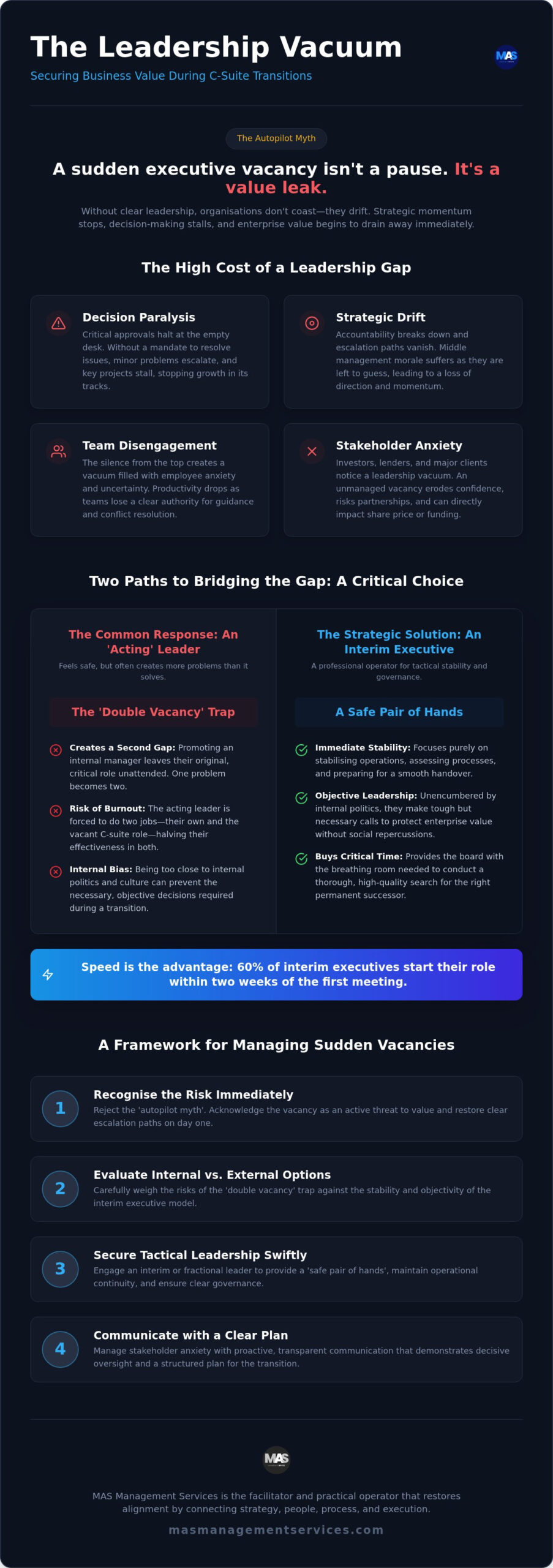
Critical approvals often stop at the empty desk. Without a designated leader, the business enters a state of paralysis. Minor issues escalate. No mandate to settle them. It’s vital to maintain a single point of accountability for key performance indicators. This is where the interim executive model becomes essential. Research indicates that 60% of interim executives start their role within two weeks of the first meeting. Rapid capability. Knowing who runs business during leadership gap periods stops hesitation.
Stakeholder and Investor Anxiety
Silence from the top breeds uncertainty. Lenders, investors, and major clients notice a leadership vacuum. They don’t want optimism; they want evidence of governance. An unmanaged vacancy erodes confidence and risks value erosion. The board must project a “safe pair of hands” to the market immediately. Stability is a choice. Active oversight. A clear plan to bridge the gap until a permanent successor is found.
Acting Leaders vs. External Interims: Avoiding the ‘Double Vacancy’ Trap
The default response to an executive departure is often internal. Appointing an ‘Acting’ leader feels safe. It’s cost-effective. It signals continuity. However, this often leads to the ‘double vacancy’ trap. By pulling a senior manager upward, you leave their original post unattended. One gap becomes two. The organisation’s capacity for execution is halved. Deciding who runs business during leadership gap phases requires a more strategic approach than simply shifting the burden to existing staff.
When Internal Promotion Fails the Organisation
Internal candidates already have a day job. Asking them to lead the entire business while managing their own department leads to burnout. They are often too close to the internal culture to make difficult restructuring decisions. While robust succession planning prepares high-potential staff for future roles, it doesn’t always equip them for the immediate pressure of a sudden vacancy. They may lack specific recovery or transition experience. Performance stalls as they learn on the job.
The Strategic Advantage of an Outsourced Executive
A professional interim focuses purely on stability and handover. They are unencumbered by internal politics. They don’t seek a permanent role. This objectivity allows them to make necessary calls regarding governance and performance without fear of social repercussions. Speed is the primary benefit. An external executive can be on-site within days. They provide a bridge. They buy the board time to find the right permanent successor. If you are facing a sudden vacancy, consider how Interim & Fractional Leadership provides immediate, hands-on support for execution. Stability is restored without compromising your existing team.
The Interim Executive Model: Tactical Stability and Governance
Leadership gaps are more than empty chairs. They represent significant operational risk. The interim executive model provides a pragmatic tool for additional capability. It answers the critical question of who runs business during leadership gap periods with a professional operator rather than a temporary placeholder. Fractional leadership further extends this. It allows businesses to access senior expertise on a part-time retainer. This provides high-level governance and oversight without the commitment of a full-time hire.
The mandate of an interim leader is specific. They stabilise the current environment. They assess existing processes. They prepare the organisation for a permanent successor. Board advisory support often works alongside this. It ensures the board maintains strategic oversight while the interim manager handles the daily execution. This dual approach protects enterprise value during high-pressure transitions.
Stabilising Performance and Accountability
Professional interims don’t reinvent the wheel on day one. They use existing operating models to maintain momentum and hit performance targets. The focus remains on role clarity. Every team member must know who is responsible for what. This prevents the decision paralysis discussed earlier. Accountability is preserved. Strategic projects continue because the escalation paths remain functional and clear.
Bridging the Gap to Growth
An executive vacancy is a rare opportunity to review the business structure. It’s a circuit breaker. This is a period where alignment becomes the primary focus. Alignment is not about getting everyone to agree. It’s about getting everyone working toward the same outcome. MAS Management Services is the facilitator and practical operator that connects strategy, people, process and execution. We ensure the transition is more than a holding pattern. It becomes a period of tactical improvement. If your organisation faces a sudden vacancy, contact us for a Free 1-on-1 Consultation to secure your operational continuity.
A Practical Framework for Managing Sudden Executive Vacancies
Managing a sudden vacancy requires more than a temporary fix. It demands a structured sequence of actions to protect the organisation’s value. A clear answer to who runs business during leadership gap periods must be established within hours, not weeks. This framework ensures stability while buying time for a quality permanent hire.
- Step 1: Board-level delegation. The board must formally assign authority and define governance oversight. Clarity is essential.
- Step 2: Proactive communication. Reach internal teams and external stakeholders before the rumour mill starts. Control the narrative.
- Step 3: Engaging Interim or Fractional Leadership. Deploy a seasoned operator to maintain operational continuity and performance.
- Step 4: Strategic review. Audit the role requirements and organisational needs before commencing a permanent search.
The First 72 Hours: Crisis Communication
Silence creates speculation. The narrative must be one of stability and control. Drafting a stability narrative prevents market speculation and employee turnover. Establishing who runs business during leadership gap situations is the first step in protecting the brand’s reputation. Prioritise key clients and financial partners. They require evidence of governance, not just optimism. Internal teams need reassurance to stay focused on targets. State the facts. Outline the interim plan. Stop the drift before it starts.
Turning a Gap into an Opportunity
A transition is a circuit breaker. It is an opportunity for necessary restructuring and recovery. Use this period to review business silos or performance issues that were previously ignored. A leadership gap allows the board to assess the business through a fresh lens. It ensures the eventual successor inherits a stable, aligned organisation. Contact MAS Management Services for a free consultation on interim leadership. We act as the practical operator that connects strategy and execution during these critical phases.
Securing Your Organisation’s Strategic Momentum
Sudden executive vacancies are high-stakes moments. They require immediate, hands-on intervention to prevent operational drift. We’ve examined why ‘acting’ roles often fail and how the interim model restores governance. The question of who runs business during leadership gap periods is a matter of active oversight, not just a temporary placeholder. Stability is a choice.
MAS Management Services provides the steady direction required to bridge these transitions. We’re specialists in fractional and interim C-suite leadership with deep experience in restructuring and recovery. Our proven board-level advisory ensures accountability remains clear while you prepare for a permanent successor. We focus on performance and role clarity when it matters most.
Don’t leave your organisation’s momentum to chance. You can maintain operational continuity through a structured, professional transition. Book a free one-on-one consultation with a senior executive advisor to discuss your organisation’s stability. Your business can emerge from this leadership gap stronger and more aligned than before.
Frequently Asked Questions
Who is legally responsible for the business if the CEO leaves suddenly?
The Board of Directors holds ultimate legal responsibility for the organisation. They have a fiduciary duty to ensure the company remains solvent and compliant during the transition. In the absence of a CEO, the board must immediately delegate authority to a temporary leader or increase their own oversight. This ensures accountability for key decisions and maintains governance standards while a permanent successor is found.
What is the difference between an interim CEO and an acting CEO in Australia?
An acting CEO is usually an internal staff member holding the position temporarily while often maintaining their original duties. An interim CEO is an external specialist hired specifically to manage the transition. Interims offer objective perspectives and dedicated focus, whereas acting leaders often face the double vacancy trap. This distinction is critical when deciding who runs business during leadership gap phases to ensure strategic momentum isn’t lost.
How long does an interim executive typically stay in a role during a gap?
Yes, fractional executives provide high-level leadership on a part-time retainer basis. They focus on high-impact strategic areas rather than administrative tasks. This model allows mid-market companies to access C-suite expertise that might otherwise be cost-prohibitive. By concentrating on governance, performance, and role clarity, a fractional leader ensures the business hits its targets without the need for a full-time, permanent salary commitment during a period of change.
What are the benefits of hiring an interim executive during a business transition?
Hiring an interim executive provides immediate stability and hands-on support for execution. They bring independent, commercially grounded perspectives to difficult decisions. Key benefits include:
- Maintaining operational continuity and hitting performance targets.
- Providing a safe pair of hands to reassure investors and stakeholders.
- Addressing who runs business during leadership gap periods with a seasoned operator who understands governance and accountability.
This approach protects enterprise value while searching for a permanent successor, giving boards the runway to work alongside specialised talent advisory firms like QNT Partners to identify and secure long-term leadership.