
What if outsourcing is not failing because of the provider, but because no one has connected the work to a shared business outcome? Leaders can make decisions function by function, then face blurred accountability across internal teams and external providers. A design outsourcing strategy starts by making that connection explicit.
Cost, capacity and access to capability may all shape a decision. But without clear ownership, workable processes and oversight, the arrangement can create activity without progress. Alignment does not mean everyone agrees on every detail. It means people understand the intended outcome and their part in achieving it.
This article sets out a practical framework to assess outsourcing options and align strategy, people, processes and execution. You will learn how to clarify the business outcome, map the work, assign accountability and establish oversight. The aim is to turn a sourcing decision into coordinated work that supports the business.
Key Takeaways
- Start a design outsourcing strategy with the business outcome, then identify which work should support it.
- Compare delivery choices against the capabilities and oversight required, not just the activities that seem easiest to outsource.
- Set clear decision rights, responsibilities and escalation paths so accountability remains visible after the choice is made.
- Prepare people and processes for the transition, then review delivery against agreed outcomes.
Why an Outsourcing Strategy Must Start With Business Alignment
An outsourcing strategy is a deliberate approach to deciding what work to source externally and why. The Outsourcing overview provides background on the practice and how it differs from offshoring. For leaders, the central question is how an external arrangement will support the organisation’s priorities, operating needs and growth direction.
Alignment does not require every team to agree on every detail. It requires people to work towards the same outcome. Alignment in an outsourcing strategy means connecting external delivery to a shared business outcome, with people, processes and ownership arranged to support it.
What should an outsourcing strategy achieve?
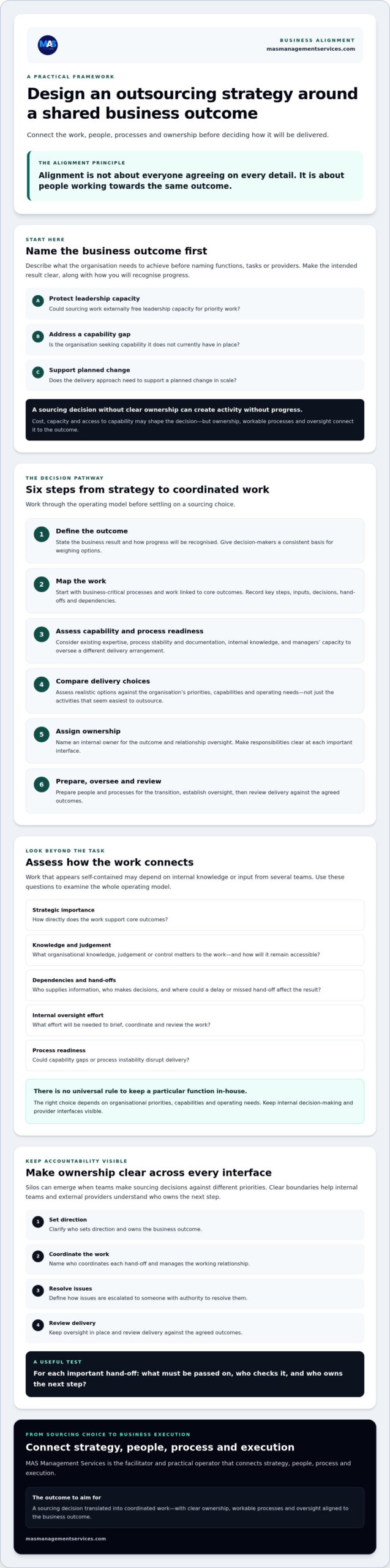
Describe the intended outcome before naming functions, tasks or providers. Is the organisation seeking to protect leadership capacity for priority work, address a capability gap or support a planned change in scale? Write down the outcome and how you will recognise progress. This gives decision-makers a consistent basis for assessing options.
Then connect the pieces: strategy sets direction, people take responsibility, processes define how work moves, and execution turns the decision into practice. A design outsourcing strategy should make those connections visible, rather than treating the sourcing choice as a standalone procurement decision.
Why outsourcing decisions can create silos
Silos can emerge when separate functions make sourcing decisions against different priorities. One team may focus on capacity, while another is expected to manage quality or integrate the work. If roles and hand-offs are not designed alongside the decision, internal staff and external providers may be unsure who owns the next step.
This is not an inevitable result of outsourcing. It is a decision-design problem. Before work moves, clarify who sets direction, who coordinates each hand-off and who resolves issues. A shared outcome gives those responsibilities a common reference point, helping teams coordinate even when their day-to-day work differs.
How to Design an Outsourcing Strategy Around the Work That Matters
Once the business outcome is clear, assess the work before considering providers. A useful sequence is to define outcomes, map the work, assess capabilities, compare delivery choices, then assign ownership. This helps leaders see how work connects across the organisation, not just which tasks could be moved externally.
Outsourcing choices should follow an assessment of how the operating model needs to work, not precede it. Examine dependencies between teams, the expertise already in place, how stable and documented processes are, and whether managers have capacity to oversee a different delivery arrangement. For organisations evaluating external technical capability to support their systems, discover saas nine for pre-qualified cloud professionals.
Which work should leaders assess first?
Start with business-critical processes and work directly linked to core outcomes. Map the key steps, hand-offs, inputs and dependencies. For each process, note who supplies information, who makes decisions and where delays or gaps could affect the result. Then consider whether capability gaps or process instability could disrupt delivery.
A task that appears self-contained may rely on internal knowledge or input from several teams. Harvard Business School’s discussion of what to outsource offers a useful prompt: assess the work’s strategic importance before choosing a delivery model.
What should stay connected to internal capability?
Consider where organisational knowledge, judgement or control is important to the work. That does not create a universal rule to keep a particular function in-house. The right choice depends on the organisation’s priorities, capabilities and operating needs. Identify what knowledge must remain accessible, who will make key decisions, and how internal teams will work with any external provider.
Compare realistic delivery choices against those requirements. For each option, consider the internal effort needed to brief, coordinate and review the work, as well as the consequences if a hand-off is missed. Then name an internal owner for the outcome and each important interface. If your organisation is assessing its approach, outsourcing strategy support can help connect the decision with practical execution.
How to Keep Accountability and Alignment After the Decision
An outsourcing decision needs ongoing governance. Set out who can make decisions, who manages the working relationship and how issues reach someone with authority to resolve them. Without these boundaries, internal teams and external providers may each assume the other owns a hand-off or outcome. For practical insights into establishing structured governance and service levels when outsourcing technical infrastructure, visit Networking2000.
Who owns results across internal and external teams?
Name an internal owner for the business outcome and relationship oversight. Then clarify responsibilities at each interface: what information or work must be handed over, who checks it, and who acts when delivery falls short of an agreed expectation. The provider may be responsible for its agreed work, but internal ownership keeps that work connected to the wider business priority.
Agree on which outcomes to review, establish a regular review rhythm and make ownership visible. Reviews should cover progress, unresolved issues and changes that could affect delivery. Keep an escalation path clear so concerns reach the right decision-maker before work stalls.
How can leaders tell when alignment is slipping?
Watch for unclear ownership, competing priorities, repeated hand-off problems or work that no longer supports the agreed outcome. These are prompts to investigate, not proof that external delivery has failed. Check where the gap occurs, who can resolve it and whether the original responsibilities still fit. Defined interfaces and active coordination help internal and external teams work as one operating arrangement.
Revisit the strategy when business priorities or operating needs change. A related guide on reducing business operating costs without cutting growth can help frame cost decisions. In your own review, test whether responsibilities and delivery still support the intended outcome.
To design outsourcing strategy oversight around clear ownership and practical execution, discuss your outsourcing strategy with MAS Management Services.
Turn the Outsourcing Strategy Into Practical Business Execution
A decision creates value only when the organisation can put it into practice. Treat the transition as a managed sequence: confirm ownership, prepare affected processes, communicate changes to the people involved, then review delivery against the intended outcomes.
What should leaders confirm before implementation?
Before work changes hands, check that the intended outcomes, responsibilities, decision rights and review arrangements are clear. Map dependencies between affected processes and identify the internal capacity needed to coordinate the change. If a key hand-off depends on knowledge held by one person or team, decide how that knowledge will remain available during the transition.
Make the changes concrete for the people involved. Explain why the arrangement is changing, what will be different in day-to-day work, where questions should go and who can resolve issues. Then review delivery against the plan and address gaps between expectations and actual operating needs.
When can outside leadership support help?
Implementation can add to the demands on leaders already managing competing priorities. When leadership capacity or continuity is under pressure, experienced executive support can help owners, boards and management teams navigate change and maintain focus on execution. MAS Management Services offers Interim & Fractional Leadership and Outsourcing Solutions, supporting organisations as they assess, design and implement an outsourcing approach.
A guide to outsourcing strategy consultants can help frame the wider questions involved. To discuss how an outsourcing strategy could fit your organisation’s needs, consider speaking with MAS Management Services about its Outsourcing Solutions.
Put Your Outsourcing Strategy Into Practice
A strong outsourcing decision starts with a clear business outcome. Assess the work, dependencies and internal capability before choosing how it should be delivered. Then define ownership, hand-offs and oversight so teams know how to coordinate and respond to issues.
That is how leaders design outsourcing strategy around business priorities and practical execution. Alignment does not require universal agreement. It means internal teams and external providers working towards the same outcome, with clear responsibilities and a way to resolve gaps.
Implementation is where the strategy is put to work. MAS Management Services works alongside owners, boards and management teams to strengthen performance and navigate change. To discuss your organisation’s needs, arrange a free one-on-one consultation.
With clear direction and accountable execution, outsourcing can become a deliberate part of how your business moves forward. Start with the outcome, then build the approach around it.
Frequently Asked Questions
What is an outsourcing strategy?
An outsourcing strategy is a deliberate plan for deciding which work an organisation will source externally, and why. It links each sourcing choice to a business outcome, such as supporting growth, improving efficiency or addressing a capability need. It also sets expectations for how internal teams and external providers will work together, including ownership, processes and oversight.
How do you design an outsourcing strategy?
To design an outsourcing strategy, first define the business outcome the decision must support. Map the work and its dependencies, then assess internal capability, process stability and management capacity. Compare suitable delivery choices against those needs rather than choosing a provider first. Finally, assign an internal owner, clarify decision rights and hand-offs, and establish how delivery will be reviewed.
What should a business consider before outsourcing a process?
Before outsourcing a process, assess its importance to business outcomes and how it connects to other work. Identify dependencies, required internal knowledge and judgement, and whether the process is stable enough to transfer. Consider who will manage the relationship, coordinate hand-offs and monitor delivery. The right choice depends on the organisation’s context. A task being routine does not automatically make it suitable to outsource.
How can a business maintain accountability when work is outsourced?
Maintain accountability by naming an internal owner for the business outcome and the working relationship. Set out what the organisation and provider each deliver, how work and information pass between them, and who can resolve issues. Agree review arrangements that test delivery against intended outcomes. Clear responsibilities do not remove the need for coordination. They make it easier to identify gaps and respond before work loses direction.
How often should an outsourcing strategy be reviewed?
Review an outsourcing strategy when business priorities, processes or operating needs materially change, and when delivery no longer supports the agreed outcome. Use regular oversight reviews to check progress, ownership, dependencies and emerging issues. A fixed calendar can support governance, but reviews should respond to relevant changes, not substitute for reassessing whether the arrangement still fits.