
What if deciding to outsource isn’t the hardest part? The real test is whether the decision supports the business priorities leaders have set. An outsourcing strategy consultant can help connect those priorities to operating choices, so outsourcing doesn’t become a separate initiative with unclear ownership. Leaders still need to decide what should remain in-house, where external support may make sense and how accountability will work.
Those concerns are valid. A change to the operating model can distract from growth if people, processes and responsibilities aren’t aligned. This article explains how to assess outsourcing against strategic outcomes, clarify governance and ownership, and move from intention to practical execution.
We’ll look at how to assess outsourcing in the context of existing operations and growth objectives, and how to maintain clear oversight as work changes. MAS Management Services works alongside owners, boards and management teams to connect strategy, people, process and execution around shared outcomes.
Key Takeaways
- Use an outsourcing strategy consultant to assess, design and implement choices tied to business priorities, not simply to find a supplier.
- Set a shared outcome to guide decisions about which activities to outsource and which to retain internally.
- Before acting, define the outcomes, examine activities, test strategic alignment and assign oversight.
- Translate the decision into clear responsibilities and practical operating changes so accountability carries through execution.
What an outsourcing strategy consultant helps a business decide
An outsourcing strategy consultant helps leaders assess, design and implement an outsourcing strategy that supports business priorities, operating needs and growth objectives. The role is not simply to find a supplier or transfer tasks. It is to help determine whether changing how work is delivered makes sense, and what the change would require from the organisation.
What does an outsourcing strategy consultant actually do?
The work starts with the current operation. Leaders and the consultant examine how activities are performed, where responsibilities sit and why outsourcing is being considered. A useful assessment separates a strategic need from a reaction to immediate pressure.
The consultant then connects the decision to the operating model. This means considering which activities may be delivered externally, which roles remain internal, and how people will coordinate and oversee the work. The concept of Outsourcing covers a range of arrangements; the right approach depends on the organisation’s purpose and circumstances. Strategy design should lead to clear roles and practical execution, not a recommendation disconnected from day-to-day operations.
When does outsourcing become a strategic question?
Outsourcing may warrant consideration when growth outpaces the current structure, during a business transition, or when leaders assess a new opportunity. These situations can expose gaps between priorities and the way work is organised. They don’t automatically mean outsourcing is the right response.
The key question is whether a different operating choice would better support the intended outcome. Leaders need to weigh the organisation’s needs, existing capabilities and capacity for change before deciding. An outsourcing strategy consultant can help owners, boards and management teams work through those choices and connect strategy, people and process. Alignment doesn’t require everyone to agree on every detail. It requires people to work towards the same outcome, with responsibilities understood.
Align outsourcing decisions with strategy, people and process
Business alignment means connecting strategy, people and processes to a shared outcome. It doesn’t require universal agreement. It requires leaders to make choices that support the same business priority and clarify how teams will contribute. That shared outcome gives decision-makers a practical basis for assessing activities and operating choices before considering external providers.
Start with the outcome, not the activity list
Begin by asking what priority the proposed outsourcing decision should support. Is the business responding to growth, seeking to improve how work flows, or making room to pursue a new opportunity? Then examine whether current roles, processes and ownership support that outcome. For example, if growth is the priority, transferring an activity won’t resolve unclear handovers or decision-making. A framework for strategic outsourcing can help leaders consider the decision in its wider organisational context.
Make accountability visible across the operating model
Before changing how work is delivered, identify who sets direction, makes decisions, monitors performance and resolves issues. Some responsibilities may cross organisational boundaries, but accountability still needs a clear owner. Map how people, processes and oversight connect, then consider where an external provider might fit. This gives teams a shared reference point, even when they hold different views about the best approach.
An outsourcing strategy consultant can help owners, boards and management teams work through these choices and connect strategy to execution. MAS Management Services takes a practical approach to linking strategy, people, process and execution. Leaders considering how outsourcing fits their operating priorities can explore MAS outsourcing solutions as part of that assessment.
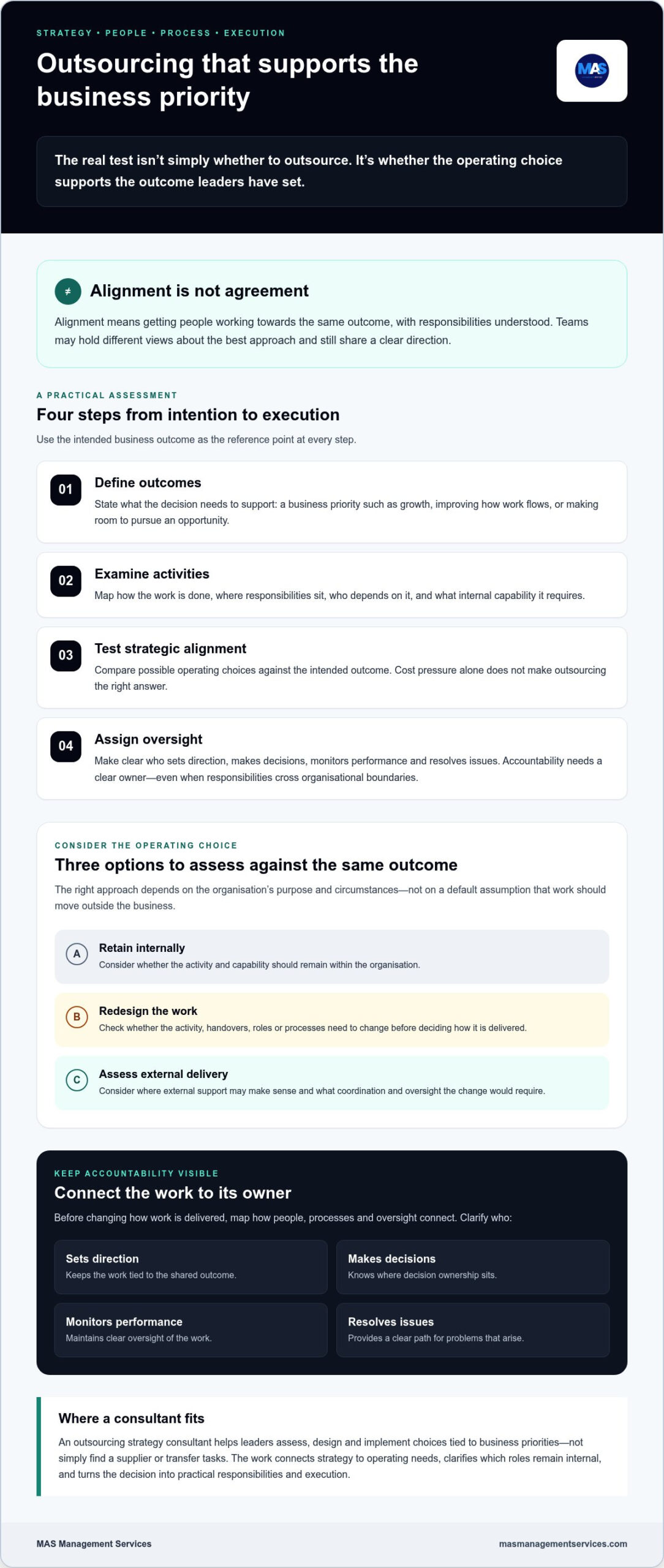
How to assess outsourcing without losing control or accountability
Cost pressure can prompt a review, but it doesn’t make outsourcing the right answer by itself. An activity may be better retained, redesigned or assessed for external delivery. The decision depends on the business outcome, how the work connects to other processes and the organisation’s ability to oversee a change.
Use a four-step assessment:
- Define outcomes: State what the business needs the decision to support.
- Examine activities: Map how work is done, who depends on it and what internal capability it requires.
- Test alignment: Compare retaining, redesigning or assessing the activity for outsourcing against the intended outcome.
- Assign oversight: Name the people responsible for decisions, review and follow-through.
Which activities should leaders assess for outsourcing?
Start with strategic importance and operating needs, not a task list alone. Consider how closely each activity supports a business priority and how it links to other work. For example, a process may rely on internal knowledge or handovers that aren’t obvious at first. Map these dependencies and identify the capabilities the business needs to retain before deciding whether to keep, redesign or assess the activity for outsourcing.
How can leaders retain oversight after a decision?
Accountability must remain explicit when delivery arrangements change. Before implementation, clarify who owns the outcome, who holds decision rights and when progress will be reviewed. Oversight should track the intended business outcome, not just whether work has moved elsewhere. If the change forms part of a wider transition, the business transition leadership guide offers a related perspective on planning.
An outsourcing strategy consultant can help leaders test these choices and make responsibilities clear before implementation begins. To discuss how outsourcing solutions could fit your business priorities, consider speaking with MAS Management Services.
Turn an outsourcing strategy into aligned business execution
A decision only becomes useful when leaders translate it into changes people can carry out. Set out what will change, who owns each responsibility and how work will move between internal teams and any external provider. For instance, when international businesses partner with Buying Office Asia for regional procurement and manufacturing support, establishing clear communication protocols and quality benchmarks ensures accountability remains intact. Keep decision rights and oversight clear. Establish review points to check whether the new arrangement remains aligned with the intended business outcome.
What practical execution support should involve
Execution needs more than a plan. It requires disciplined follow-through across strategy, people and process. Leaders may need to clarify roles, adjust workflows and explain how responsibilities will work in practice. An outsourcing strategy consultant can help connect these decisions and support better decision-making while accountability remains with the organisation.
MAS Management Services provides outsourcing solutions consulting to assess existing operations, design an appropriate strategy and support implementation. Its approach connects business priorities with the people, processes and responsibilities needed to put a decision into practice. It recognises that each organisation’s operating needs differ and does not assume every business needs the same model.
When to speak with MAS Management Services
A conversation may be useful when leaders need to assess outsourcing against current operations and growth objectives, or when a proposed change raises questions about ownership and follow-through. The discussion can help clarify the situation and the decisions ahead. It is an opportunity to explore the options, not a commitment to outsource or a guarantee that outsourcing is the answer.
MAS Management Services offers a free 1-on-1 consultation. If you’re weighing an operating-model change, use that conversation to discuss your organisation’s priorities, current arrangements and accountability needs.
Put the operating decision into practice
Outsourcing is a strategic choice, not an automatic response to cost pressure. Assess it against the business outcome, the activities involved and the way work, people and responsibilities connect. Keep ownership and oversight explicit as delivery arrangements change. Alignment means working towards a shared outcome, even when leaders don’t agree on every detail.
An outsourcing strategy consultant can help connect business priorities to operating choices and practical execution. MAS Management Services works alongside owners, boards and management teams to support disciplined follow-through and better decision-making by connecting strategy, people, process and execution.
If your organisation is weighing an outsourcing decision, a conversation can help clarify how it fits current operations and growth objectives. Arrange a free one-on-one consultation with MAS Management Services to discuss your situation and the decisions ahead.
Frequently Asked Questions
What does an outsourcing strategy consultant do?
An outsourcing strategy consultant helps leaders assess, design and implement an outsourcing strategy that fits business priorities and operating needs. This can include reviewing existing operations, considering which activities to retain or redesign, and clarifying how responsibilities and oversight will work if delivery changes. The focus is broader than selecting a supplier. It connects the decision to the organisation’s operating model and practical execution.
When should a business consider an outsourcing strategy consultant?
Consider engaging an outsourcing strategy consultant when growth, a transition or a new opportunity prompts questions about how work is organised. These circumstances don’t automatically call for outsourcing. They may instead reveal unclear ownership, processes that need redesign or capabilities the business should retain. A consultant can help leaders assess the options against current operations and growth objectives before committing to a change.
Is outsourcing always cheaper than keeping work in-house?
No. Outsourcing isn’t automatically cheaper, and cost pressure alone doesn’t establish that it’s the right choice. Leaders need to assess the operating implications, including the work involved, its dependencies and the oversight required. Compare the options against the intended business outcome. Depending on the situation, retaining or redesigning an activity may be more appropriate than changing how it’s delivered.
How can a business maintain accountability after outsourcing?
A business can maintain accountability by defining internal ownership before delivery arrangements change. Clarify who holds decision rights, who oversees the work and how progress will be reviewed against the intended outcome. Keep responsibilities clear where work crosses organisational boundaries. Transferring delivery doesn’t transfer the need for internal oversight. Review arrangements as the operating model changes so decision-makers can address gaps.
Does MAS Management Services provide IT outsourcing?
No. MAS Management Services does not provide IT or technology outsourcing. Its service is Outsourcing Solutions, which involves consulting to assess, design and implement outsourcing strategies tailored to existing operations and growth objectives. When an organisation determines that specialised technical work—such as structured network cabling and managed systems from Trinity Networx, LLC—is appropriate, external providers handle delivery while internal governance remains key. Leaders considering whether outsourcing is appropriate can discuss their situation with MAS. The focus is on connecting business priorities with practical decisions, clear accountability and disciplined execution.