
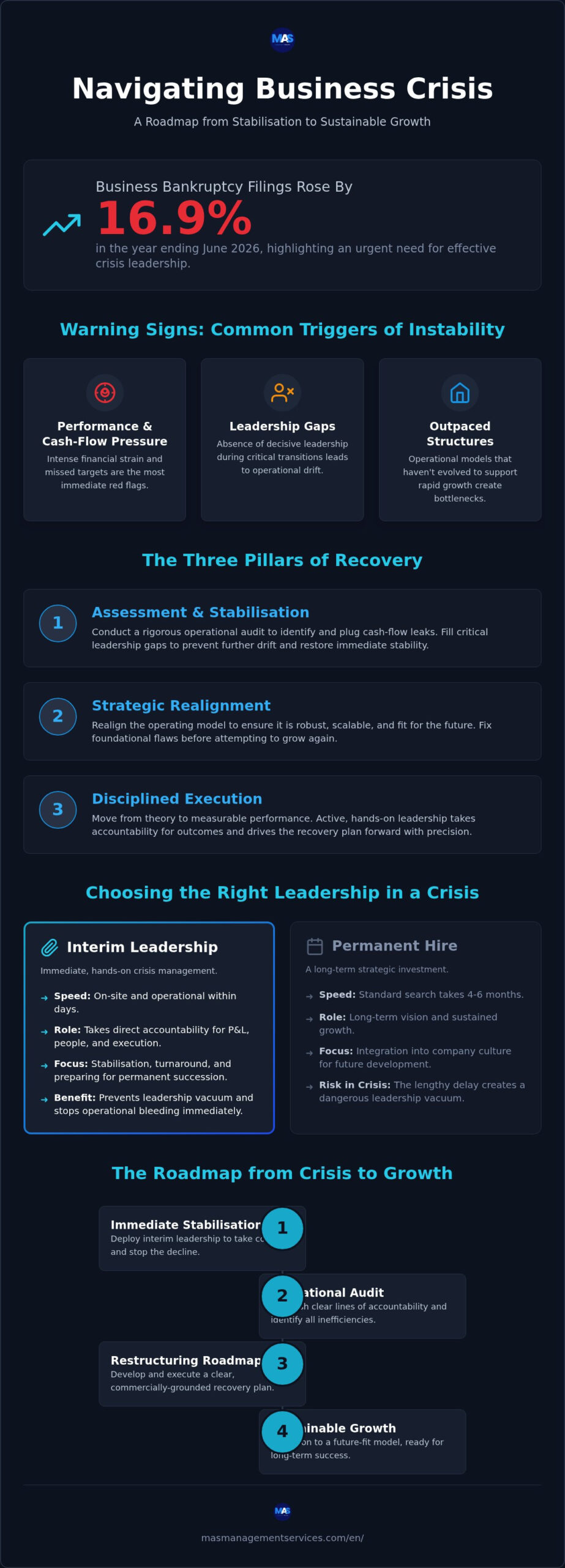
Business bankruptcy filings rose by 16.9 percent in the year ending June 2026. It’s a sobering reality for many boards. When cash flow tightens, the need for effective executive leadership for business in crisis becomes immediate. You’ve likely felt the weight of outpaced structures that can no longer scale. You don’t need more theory. You need practical action.
The strain of leadership gaps during critical transitions is significant. This guide outlines how seasoned interim leadership and disciplined execution stabilise an organisation in distress. We’ll show you how to move from immediate operational stability to a clear restructuring roadmap. You’ll discover how independent, commercially grounded oversight builds lasting enterprise value.
The path forward requires a steady hand on the wheel. We’ll examine the specific steps needed to restore accountability and ensure your business is fit for the future. It’s about moving from survival to sustainable growth. This is the roadmap to recovery.
Key Takeaways
- Identify the triggers of instability, from performance pressure to outpaced structures, and learn how disciplined strategy restores order.
- Discover how seasoned executive leadership for business in crisis provides the immediate oversight needed to plug cash-flow leaks and stabilise operations.
- Understand the speed and commercial benefits of fractional leadership models for filling critical capability gaps without the overhead of permanent hires.
- Establish clear lines of accountability through a rigorous operational audit to move your organisation from survival back to sustainable growth.
Defining Executive Leadership for a Business in Crisis
Crisis leadership is the disciplined application of strategy and execution during periods of high uncertainty. It isn’t merely a set of recommendations. It’s the active management of a company’s survival. Effective executive leadership for business in crisis prioritises immediate action over theoretical planning. The focus remains on the “doing.”
Several triggers usually precede a downturn. These include:
- Intense performance and cash-flow pressure.
- Leadership gaps during critical transitions.
- Operational structures that have been outpaced by rapid growth.
When these issues emerge, internal promotion can be problematic. Existing staff are often too close to the problem or entangled in internal politics. External, independent leadership provides a clean break. The primary objective is to move from immediate stabilisation to the creation of lasting enterprise value. By applying proven Crisis Management Strategies, a business can regain its footing. This approach ensures the recovery is commercially grounded and objective.
The Role of the Interim Executive
An interim leader provides essential continuity. They fill capability gaps when a permanent executive is absent, preventing operational drift. For organisations looking to strengthen internal leadership capabilities alongside interim support, executive coaching from Simon Lead LLC can help existing managers navigate high-pressure demands. This approach offers a steady hand. It manages the concerns of stakeholders and staff alike. The leader doesn’t just observe; they take accountability for the transition’s success. It’s about maintaining momentum while a long-term solution is organised.
Why Independent Oversight Matters
Independent advisors bring an objective perspective that’s often missing in a distressed organisation. They provide support free from the weight of historical decisions. This clarity is vital when making difficult restructuring choices. Executive leadership for business in crisis requires an honest appraisal of what works and what doesn’t. Objective oversight ensures that every decision serves the recovery of the business rather than individual interests.
The Three Pillars of Operational Restructuring and Recovery
Effective executive leadership for business in crisis relies on three fundamental pillars. Assessment and stabilisation. Strategic realignment. Disciplined execution. The first phase involves a rigorous audit to identify cash-flow leaks and critical leadership gaps. Once the immediate pressure is managed, the operating model must be realigned to ensure it is fit for purpose. Harvard’s Take on Crisis Leadership suggests that this transition requires a blend of technical skill and human influence. It’s about moving from theory to measurable performance.
Success requires more than advice. It demands active involvement. Our corporate turnaround services focus on these pillars to ensure the business regains its commercial footing. The goal is a resilient enterprise. We take responsibility for the outcomes.
Stabilising Performance and Cash Flow
Cash flow is the immediate priority. Boards often hesitate to engage external help due to cost concerns. However, a fractional executive often reduces overall expenses through rapid efficiency gains. They identify waste and stop the bleeding. Accountability is central to the recovery programme. Every dollar must be tracked. Every process must be justified. This hands-on oversight provides the breathing room needed for long-term planning.
Improving Operating Models to Scale
Crisis often stems from success that has outpaced structure. An outdated operating model cannot support current growth. It creates bottlenecks and performance pressure. Execution-led leadership fixes these foundational flaws before attempting to scale again. We rebuild the structure to ensure it is robust and scalable. If your board needs an objective view, a free 1-on-1 consultation can help clarify the path forward.
Interim vs. Permanent Leadership During a Transition
Speed of deployment is the primary differentiator. A standard executive search often takes four to six months to complete. In contrast, an interim executive can be on-site and operational within days. For a board managing executive leadership for business in crisis, this time difference is the difference between recovery and failure. You can’t afford a leadership vacuum when performance is under pressure. Unlike traditional management consultants who only provide advice, an interim leader steps into the role. They take responsibility for the P&L and the people. They execute.
This hands-on approach prepares the organisation for a successful permanent succession. The interim leader stabilises the culture and cleans up operational inefficiencies. They ensure the incoming permanent hire inherits a functional, organised business rather than a mess. It’s a strategic bridge that protects enterprise value. By the time the permanent replacement arrives, the crisis has been managed and the roadmap is clear. The foundation is secure.
The Fractional Leadership Model
Fractional leadership provides senior executive capability on a part-time, high-impact basis. It’s a cost-effective solution for SMEs that need C-suite expertise without the overhead of a full-time salary. Common roles include:
- Interim CEO for strategic turnaround.
- Interim CFO for financial restructuring.
- Interim COO for operational oversight.
Filling the Leadership Gap
Leaving a leadership vacancy open for too long during a crisis invites instability. It creates anxiety among staff and erodes stakeholder trust. A fractional executive provides immediate stability while the search for a permanent hire continues. They keep the wheels turning and the strategy on track. They provide the commercially grounded oversight needed to navigate high-pressure transitions. If your business is facing a transition, you can book a free 1-on-1 consultation to discuss your requirements.
Executing the Strategy: From Stabilisation to Growth
Execution is where strategy meets reality. Effective executive leadership for business in crisis moves through four distinct steps. First, establish immediate oversight and governance. This ensures clear lines of accountability from the outset. Second, conduct a deep operational audit. This process identifies the specific operating model flaws that triggered the crisis. Third, implement the restructuring plan with disciplined execution. This isn’t about suggestions. It’s about making the difficult calls that restore performance and protect capital. Finally, transition to long-term leadership. This ensures the organisation is more resilient than it was before the downturn. The business must emerge stronger.
Board and Strategic Advisory
Experienced board-level advisors provide the necessary governance oversight for a successful turnaround. They bring a commercially grounded perspective to the table. This helps boards make better decisions under intense performance pressure. The goal is building lasting enterprise value. By focusing on risk management and performance oversight, advisors ensure the business remains on a stable path. They provide the independent check required to validate the recovery strategy. It’s about providing the board with the confidence to act decisively. Clarity of purpose is essential for recovery.
Designing the Growth Path
Recovery isn’t just about survival. It’s about setting the stage for future transformation. Once the business is stable, the focus shifts to sustainable growth. This requires a shift from defensive measures to an offensive strategy. We help you design an operating structure that supports your long-term vision. The transition to a permanent team should be seamless and well-timed. It’s the final step in building a better business. If you need a partner to lead this transition, schedule a free one-on-one consultation with MAS Management Services. We take responsibility for the outcome.
Securing Your Organisation’s Future
Stabilising a business requires more than just high-level advice. It demands the disciplined application of strategy, leadership, and execution. We’ve explored how interim leadership provides the immediate oversight needed to manage cash-flow pressure and leadership gaps. By focusing on the three pillars of restructuring, boards can move from survival to building lasting enterprise value.
Effective executive leadership for business in crisis is about taking accountability for outcomes. It involves establishing clear governance and fixing the foundational flaws in your operating model. MAS Management Services provides practical executive support when it matters most. We offer independent, commercially grounded support for owners and boards navigating high-pressure transitions.
If your organisation needs a steady hand, book a free one-on-one consultation with a senior executive advisor today. Resilience is built through action. With the right leadership in place, your business can emerge from uncertainty stronger and more focused than before.
Frequently Asked Questions
What is the difference between a crisis manager and an interim executive?
A crisis manager often focuses on short-term fire-fighting or insolvency risks. An interim executive provides broader executive leadership for business in crisis by taking full operational accountability. They embed themselves into the organisation to manage the P&L and staff. While a manager might advise on specific problems, an interim leader ensures continuity and prepares the foundation for a permanent successor. They lead the recovery from within the team.
How quickly can an interim leader be embedded into my organisation?
Deployment is typically rapid. It often occurs within days rather than the months required for permanent recruitment. Because these leaders are seasoned professionals, they don’t require lengthy onboarding. They arrive ready to assess critical leadership gaps and plug cash-flow leaks immediately. This speed is vital for businesses facing performance pressure where every day of vacancy increases the risk to the organisation’s lasting enterprise value.
Is fractional leadership suitable for a business in financial distress?
Yes, fractional models are highly effective for businesses under financial strain. You gain access to senior C-suite expertise without the overhead of a full-time executive salary. These leaders focus on high-impact areas like Restructuring & Recovery to stabilise the balance sheet. They identify operational inefficiencies and stop the bleeding. It’s a commercially grounded way to secure senior oversight while managing tight capital constraints.
What are the first steps an interim CEO takes to stabilise a business?
The process begins with an immediate operational audit and a review of governance. The leader establishes clear lines of accountability to ensure every decision is commercially grounded. They prioritise cash-flow management and identify any outpaced structures causing bottlenecks. By stabilising the core functions first, they create the breathing room necessary to design a long-term restructuring roadmap for the board and owners.
Do I need a restructuring consultant or a full-time leader?
A consultant usually provides a report, but a leader provides execution. If your organisation lacks the internal capability to implement change, a hands-on executive is the better choice. They don’t just identify the operating model flaws; they take responsibility for fixing them. This embed approach ensures that executive leadership for business in crisis translates into measurable performance improvements rather than just a set of theoretical recommendations.