
Across-the-board cuts can lower spend and weaken a business at the same time. A reduce business operating costs consultant should help leaders look beyond what can be removed and identify which costs still support business priorities.
Cost pressure can make those priorities harder to distinguish. Cutting evenly may affect the people, processes and customer delivery the business relies on, while spending that no longer fits its direction continues unchecked.
Reducing operating costs without cutting growth starts with alignment. This article sets out a practical way to review spending against current priorities, assign accountability and follow decisions through. It also looks at how to protect the capabilities needed for performance and growth by connecting strategy, people, process and execution.
Key Takeaways
- Set clear business priorities before reviewing costs, so decisions focus on spending that supports performance and growth.
- Trace costs to the people, processes and activities they enable to identify where spending may be out of alignment.
- Test options in sequence, assign ownership and review implementation before making further changes.
- Consider when a reduce business operating costs consultant could help clarify decision-making, scope and accountability across teams.
Why reducing business operating costs starts with the right question
Cost pressure can make a quick budget cut feel like the obvious response. But the size of an expense alone doesn’t show whether it supports essential work, customer delivery or growth. A better question is: which spending no longer serves the outcomes the business needs?
Cost reduction means aligning spending with business priorities, not simply shrinking the budget. Alignment doesn’t require everyone to agree on every detail. It does require a shared understanding of the outcomes the business is working towards. Start by clarifying what counts as an operating expense. Operating expense (OpEx) generally refers to the ongoing costs of running a business, distinct from capital expenditure. That distinction can help frame a review, but the purpose of each cost matters more than its label.
When cost pressure signals a wider business issue
Growth may outpace the structure supporting it. Performance pressure can expose duplicated work or unclear decision-making. Priorities may also be difficult to translate into daily activity. These are reasons to examine how the operating model, accountability and execution fit together, not proof that a particular team or expense is the problem.
Before changing spend, clarify which outcomes matter and who is responsible for delivering them. Without that direction, cuts can land unevenly while the underlying issue remains unresolved.
Which costs support the outcomes the business needs?
For each significant cost area, ask which stated priority it enables. Consider the people, processes and activities behind the spend. A cost may sustain a capability the business relies on, even if it doesn’t produce an immediate, visible return. Another may support work that no longer fits the intended direction.
Separate capability from activity. Protect what is needed for performance, then investigate what could change, stop or be redesigned. If leaders need support connecting strategy, people, process and execution, a reduce business operating costs consultant may help bring more clarity and accountability to the review.
How to identify operating costs that are out of alignment
Start with current priorities, not the expense ledger. Agree what the business must protect or deliver, such as reliable customer service, continuity of a core process or a defined growth objective. Then review significant cost areas against those outcomes. Harvard Business Review’s guidance to connect costs to their strategy reinforces why spending decisions need to reflect the business’s direction.
Cost data needs operational context before it can guide action. A line item shows what is spent, but not which work it enables or what might be affected if it changes.
Map spending to strategy, process and accountability
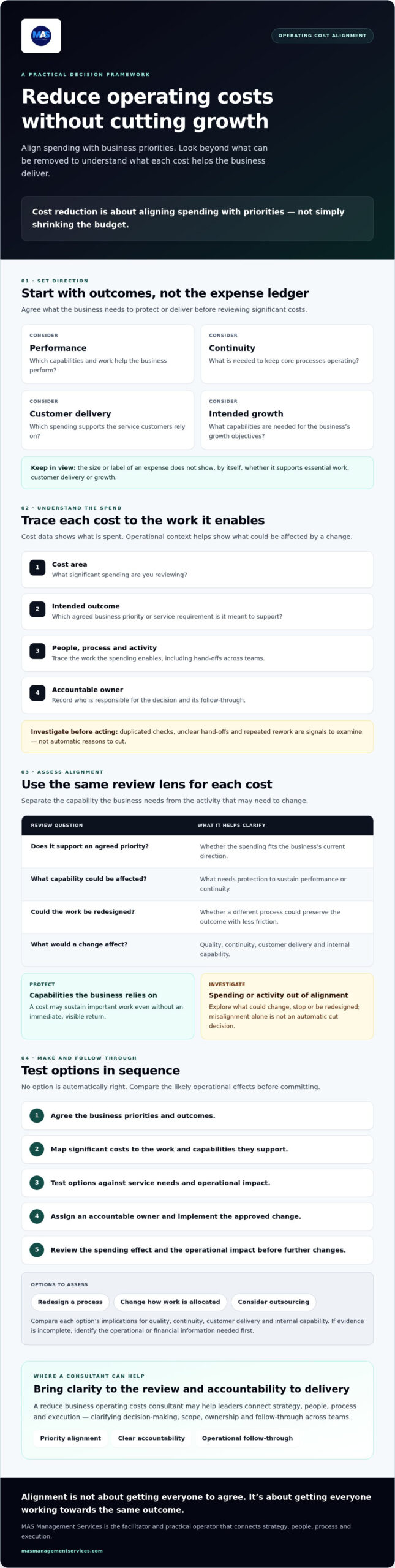
For each cost area, record the outcome it is intended to support, the activity it funds and the person accountable for the decision. Trace the work across teams. A process may involve duplicated checks, unclear hand-offs or effort that no longer supports an agreed priority. Treat these as signals to investigate, not automatic reasons to cut. Ask whether redesigning the work could preserve the outcome with less friction.
Assess each activity against performance, continuity, customer delivery and intended growth. This makes trade-offs easier to see and gives decision-makers a shared basis for discussion.
Separate immediate pressure from structural misalignment
A short-term cash-flow concern may call for careful timing and oversight. Persistent operating friction, such as repeated rework or unclear ownership, calls for a closer look at the operating model. Treating both as the same problem can produce temporary savings without addressing the cause.
For a related perspective, see Outsourcing strategy consultant: align decisions with execution. Where leaders need help connecting cost decisions to accountability and follow-through, a conversation through MAS’s Free 1-on-1 Consultation may be a practical next step.
How to reduce operating costs without undermining performance
Use a sequence that connects each decision to its intended outcome. First, agree on priorities. Then test possible changes against service requirements and the capabilities the business needs. Assign an accountable owner, implement the approved change, and review both the spending effect and the operational impact.
Options may include redesigning a process, consolidating suppliers for routine procurement, changing how work is allocated or considering outsourcing. For businesses looking to trim everyday administration expenses, check out Mega Office Supplies for competitive pricing on day-to-day workplace essentials. None of these options is automatically the right answer for every line item, so compare each option’s implications for quality, continuity, customer delivery and internal capability. If the evidence is incomplete, identify what operational or financial information is needed before committing.
Make cost decisions without defaulting to across-the-board cuts
Apply the same questions to each proposal:
- Does it support an agreed strategic priority or service requirement?
- What capability could be affected if the cost changes?
- Is there evidence that the proposed saving is achievable without shifting work or risk elsewhere?
Uniform cuts treat essential and non-essential activity as though they have equal value. A more considered approach lets leaders compare options and pause when the likely effect is unclear.
Keep execution connected to the decision
Accountability should sit with the person responsible for the outcome, not only the budget line. That person should explain what is changing, who is affected and how progress will be reviewed. Monitor spending alongside relevant operating signals, such as service delays, rework, customer feedback or team capacity. These indicators provide context, but they aren’t universal benchmarks.
Review what happens after implementation. If a change creates unintended pressure on another process or weakens delivery, investigate and adjust the approach. A reduce business operating costs consultant may help leaders keep direction and execution connected.
For practical executive support with cost decisions and accountability, book a Free 1-on-1 Consultation with MAS Management Services.
When a cost reduction consultant helps and what to do next
External support may be useful when cost decisions cross functions, priorities compete or no one has clear ownership of implementation. A reduce business operating costs consultant should help clarify the decision process, rather than treat the spreadsheet as the whole picture. The review needs to account for strategy, operating processes, current constraints and the people responsible for delivery.
What to clarify before engaging a consultant
Before agreeing on a scope, ask how the adviser will understand the business’s priorities and how work currently moves across teams. Clarify which decisions remain with owners, the board or management, who will implement agreed changes, and how progress and operational effects will be reviewed. These questions help establish whether the engagement supports practical execution as well as analysis.
How MAS Management Services approaches business change
MAS works alongside owners, boards and management teams to strengthen performance, navigate change and build lasting enterprise value. Its services include Interim & Fractional Leadership, Growth & Transformation, Restructuring & Recovery, and Board & Strategic Advisory. The relevant support depends on the circumstances. The focus is practical executive support for performance and change, with clear direction and disciplined execution.
For decisions about outsourcing, explore Outsourcing strategy consultant: align decisions with execution. Outsourcing is one option to assess against business priorities, not a default cost-cutting measure. Before deciding whether it fits, leaders should understand the work involved and what capability and oversight the business needs.
If cost decisions are difficult to coordinate or ownership is unclear, discuss your business’s circumstances with MAS in a free one-on-one consultation. Use the conversation to outline the challenge, clarify what support may be relevant and consider a practical next step.
Turn cost pressure into focused action
Reducing operating costs without weakening growth depends on clear priorities, not blanket cuts. Link spending to the outcomes the business needs, then assess what each change means for capability, service and performance. Give decisions clear owners and review their effects after implementation.
A reduce business operating costs consultant may help when choices span teams or accountability needs strengthening. MAS Management Services works alongside owners, boards and management teams, providing practical executive support focused on performance and business change. Its approach connects strategy, people, process and execution so decisions can move into action.
Start with the issue your business needs to resolve and the outcomes you need to protect. Arrange a free one-on-one consultation with MAS Management Services to discuss your circumstances and consider a practical next step. With clear direction and ownership, cost decisions can support a stronger foundation for performance and growth.
Frequently Asked Questions
How can a business reduce operating costs without cutting growth?
Align cost decisions with the business’s current priorities and the capabilities needed to deliver them. Review what each significant expense enables, then compare options against service requirements, performance and growth plans. Avoid uniform cuts that treat all spending alike. Assign an owner to each approved change and review both its financial effect and any impact on customers, processes or team capacity.
When should a business engage a cost reduction consultant?
Consider external support when cost decisions cross functions, priorities conflict or accountability for implementation is unclear. A reduce business operating costs consultant can help leaders connect spending decisions with strategy, operating processes and execution. Before engaging support, clarify the scope, who retains decision authority, who will implement agreed changes and how progress will be reviewed. The adviser’s role should fit the business’s actual needs.
What should a business cost review include?
A useful cost review starts with agreed business priorities, then traces significant spending to the people, processes and activities it supports. Assess whether each activity contributes to performance, continuity, customer delivery or intended growth. Identify duplicated work, unclear hand-offs and spending without a clear connection to priorities. Record decision ownership and what evidence is needed before making changes, then monitor operational effects after implementation.
Can outsourcing help reduce business operating costs?
Outsourcing may be an option, but it isn’t automatically the right choice. Assess the work involved, the capability and oversight the business needs, and the implications for service and continuity. For specialised operational functions, partnering with external providers such as Mbawine Consultant Services for technical training and certification can help maintain standards while controlling internal overheads. Compare it with process redesign or other ways to address the cost. Define the intended outcome and implementation responsibilities before deciding whether outsourcing supports business priorities.